Learn what community cloud is, how it works, key benefits, and why regulated industries use it to balance security, compliance, and cost.
A cloud infrastructure configured to supplement the common requisites of multiple businesses is a community cloud. It helps them comply with industry-oriented regulations while accessing shared services and resources.
Simply put, a shared community garden, where multiple individuals produce their yield on a shared land piece, is analogous to the idea of a shared environment. In a similar vein, enterprises with shared objectives or legal requisites can utilize and create a community space.
The healthcare, government, and educational sectors find this approach especially intriguing since it provides a middle ground between public and private clouds. We will unfold the functioning, architectural configurations, merits, and nuanced features of community framework.
The community cloud computing functions similarly to other (public) cloud solutions, in which software and services are provided by a third party either for free or at a cost. Servers, storage, databases, networks, software, and analytics services are among the resources it offers.
But unlike a public cloud, access to community architecture is limited to certain individuals, and service usage is governed by specified rules. Because it is client-capable and enables the addition of new members and scalable resources as needed, it also operates similar to private cloud based output management.
A community cloud model is designed exclusively to fulfil the common requirements of multiple users. These members work in unison to share resources such as software, bandwidth, and storage. They typically belong to the same organizational or industry network.
Member organizations can collaborate with a managed hybrid cloud vendor or host the infrastructure in their own data centers. Although a shared environment surpasses public clouds in terms of compliance and security, cautious set up and preparation is essential to ensure hassle-free cooperation.
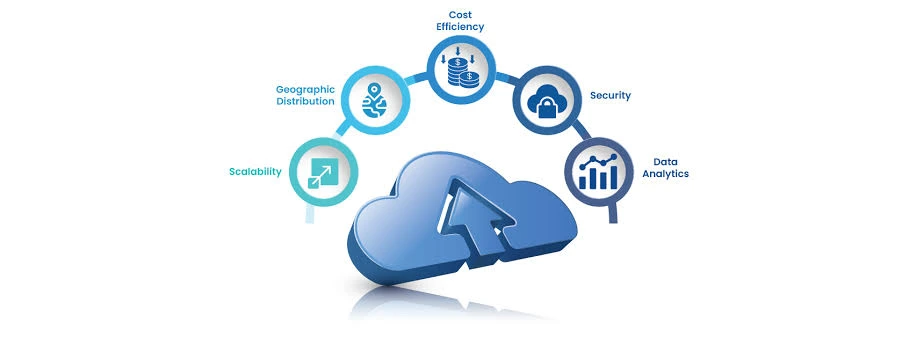
Community cloud advantages enable organizations with similar needs to share cloud infrastructure while maintaining security, compliance, connectivity, and operational efficiency.
The uncertainty of non-compliance is alleviated by shared configurations of industry norms such as HIPAA (for healthcare) and PCI DSS (for payment processing).
All member organizations can save infrastructure expenses by sharing resources. This configuration ensures logical segmenting of user sessions without any need for different servers.
Shared environments are made to have as little downtime as possible, ensuring continuous service.
Industry-specific norms demand robust security measures. Community space can seamlessly accomplish this by unifying member-shared skills and technologies.
Compared to public clouds, community spaces provide more control, enabling users to tailor the system to their needs.
The defining features of a shared environment focus on controlled multi-tenancy, standardized security frameworks, and shared governance tailored to businesses with common operational needs.
Despite the shared infrastructure, each member organization has autonomous authority over its own data and can deploy forbidden access restraints to ensure that data is kept aloof from other community members.
Such facility ensures adherence to cloud security compliance standards and data security laws including HIPAA and GDPR.
In a community workspace, a suite of businesses with comparable objectives or legal requirements collectively own or rent the infrastructure.
For instance, a suite of hospitals can set up a community space to share research data and healthcare apps. This would help maintain the privacy and confidentiality of patients’ clinical data.
Multi-tenant infrastructure lets several enterprise members share the same cloud ecosystem. However, the community configures specialized frameworks for workflows and shared apps that fulfil everyone’s requirements, including compliance checks and conventional encryption.
Every member of the community framework is still free to execute their individual operations.
Businesses share a unified suite of computing resources for effective resource usage.
All participants share the expenses of infrastructure and security maintenance. Unlike private cloud solutions, this is practiced on resource usage, leading to paramount cost savings.
While both entities assist modern business requisites, they are distinctly nuanced in use case, governance, and architecture.
| Hybrid Cloud | Community Cloud |
|---|---|
| Unifies private and public cloud infrastructure for data security and cost-efficiency. | Developed on private cloud models for businesses with shared requirements. |
| Reduces cost while securing sensitive data. | Fulfils business needs through centralized ecosystem. |
| Collaborates private cloud (for sensitive data) and public cloud (for non-sensitive data). | Communication Service Providers (CSPs) provide shared private cloud. |
| Non-sensitive data in public cloud; sensitive data in private environments. | Data hosted on a shared network aligns with common security needs. |
| Customization depends on data sensitivity and workload. | Customization is confined to the shared requisites. |
| Suitable for big data analytics of non-sensitive data. | Suitable for businesses with similar operational requirements. |
Community space delivers a compelling intermediate foundation between shared efficiency and secure control. By facilitating business with shared compliance, security, and operational requisitions to collaborate on a cloud ecosystem, it offers cost optimizing without compromising governance.
Community workspace is emerging as a future-ready, practical choice for enterprises seeking trust, scalability, and flexibility.
Industries such as healthcare, financial services, education, and government leverage the most due to common data security and regulatory requirements. Community space aids these sectors sustain cost-effectiveness and compliance.
It interoperates with hybrid and private ecosystems through safer APIs and network fragments. This enables businesses to expand workloads while coordinating control over proprietary or sensitive data.
Several community spaces integrate federated governance structures, where central policies describe baseline regulations while individual businesses exercise control over data ownership, access, and risk mitigation within set boundaries.