Explore how co-packaged optics and silicon photonics improve bandwidth, power efficiency, and connectivity for next-generation AI data center clusters.
Every new AI cluster asks more of its network. Thousands of accelerators trade data constantly, and when links lag or drop, expensive compute sits idle.
That’s why co-packaged optics has moved from research labs to production lines. It changes where electrical signals become light, which affects power, reliability and scale. Here’s what it does, where copper still wins and what to ask before you buy.
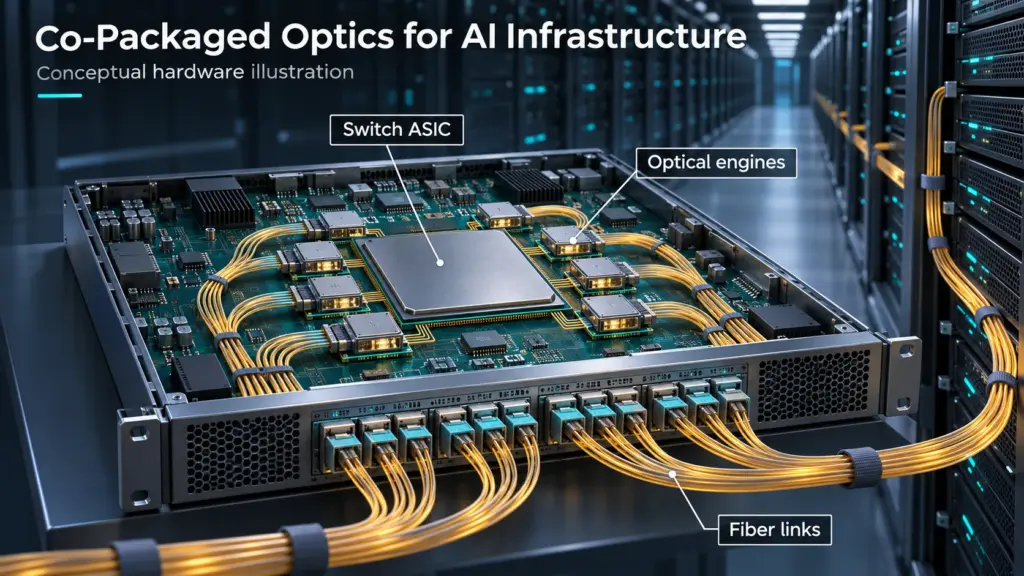
Co-packaged optics places optical engines on the same package as a switch chip. In a conventional switch, those conversion parts sit inside pluggable transceivers on the front panel. The signal has to cross circuit board traces and connectors before it ever becomes light.
That trip is costly. NVIDIA puts the electrical loss at up to 22 dB on a 200 Gb/s channel in a pluggable design. With CPO, it falls to roughly 4 dB.
So, what is co-packaged optics technology in practical terms? It’s a way to shrink the electrical path to a very short hop. Cleaner signals need less correction, which saves energy.
The switch chip sends an electrical signal to an optical engine right beside it. A modulator inside that engine encodes the data onto laser light. Fiber carries the light out of the chassis, and a receiver at the far end turns it back into an electrical signal.
Silicon photonics makes this compact enough to work. It builds waveguides, modulators and detectors on silicon using chip manufacturing methods.
Lasers often stay separate. Broadcom’s design, for example, uses field-replaceable laser modules. That lets technicians swap a failed light source without replacing the whole switch.
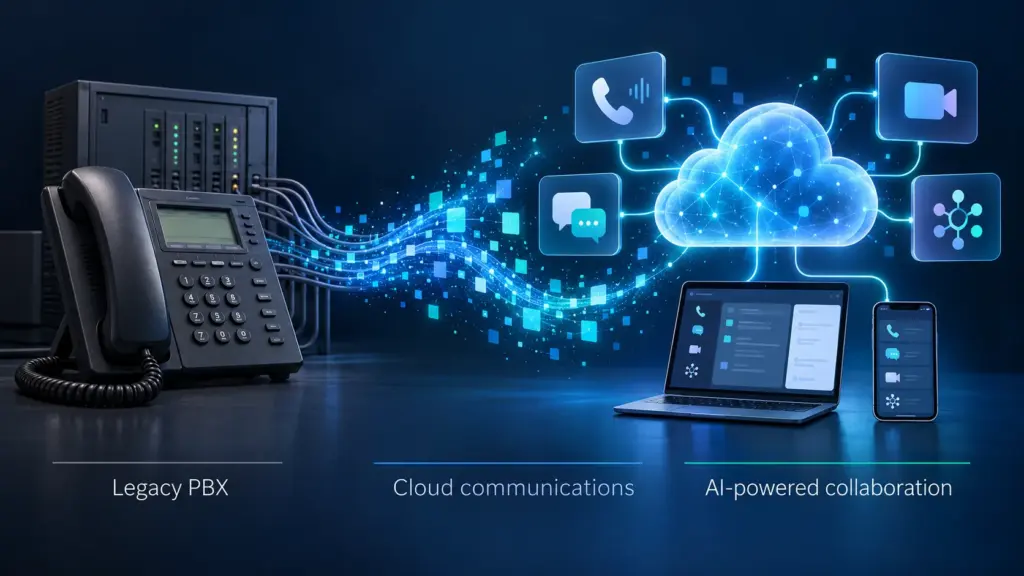
The choice between copper vs optical interconnects in data centers comes down mostly to distance, speed and power. Copper is simple, affordable and dependable over short runs. Passive cables don’t convert signals into light, so they add very little delay or power draw.
The trouble starts as speeds climb. Signal loss rises with frequency, which shortens copper’s useful reach. Engineers can push farther with signal processing and error correction, but both add power and latency. A Cadence engineering leader writing in HPCwire says copper stays highly effective up to a few meters, such as inside a rack or between closely spaced racks.
Optical interconnects hold signal quality over far longer distances, from rack rows to entire campuses. The tradeoff is the added power and complexity of converting between electricity and light.
Copper isn’t disappearing. Use it where it’s most efficient, and use light where reach demands it.
Training a large model spreads one job across many processors. They exchange results again and again, so a single unstable link can slow everyone down. That makes AI cluster networking a direct factor in how much value you get from your accelerators.
NVIDIA’s 2025 comparison showed a pluggable interface often drawing 30 watts, against as little as 9 watts with CPO. Every watt saved in the network is a watt your facility can potentially hand to compute.
Broadcom’s Tomahawk 6 Davisson switch delivers 102.4 Tb/s and was sampling to early access customers in October 2025. The company reports 70% lower power for its optical links than with traditional pluggables.
NVIDIA said in August 2026 that its Spectrum-X Ethernet Photonics platform had entered full production. It claims five times lower power consumption, four times fewer lasers and ten times longer mean time between incidents. The largest system in that family reaches 409.6 Tb/s. Three of those switches together would exceed one petabit per second of switching capacity.
Treat these figures as vendor claims. Baselines and measurement methods differ, so test them against your own traffic and topology.
Pluggables remain dominant because they’re familiar and easy to replace. CPO trades away some of that freedom because optical engines are built into the switch package.
Before you commit, put these questions to your vendors:
Start where network power and link stability already limit performance, usually the back-end fabric that connects accelerators. Compare results with your pluggable baseline before expanding.
Your long-term plan for data center connectivity will likely mix technologies. Each has a place.
Co-packaged optics won’t replace every cable, but it changes the math for large AI builds. Shorter electrical paths can cut power, reduce component counts and support greater bandwidth density.
The smartest next step is to map your current links by distance, power and failure history. That picture will show where your high-speed data center interconnects need optics first, and where copper still earns its place. It’ll also give your data center optical networking roadmap a clear starting point.
It puts optical engines next to the switch chip on a shared package. The chip sends electrical signals a very short distance, the engine converts them into light and fiber carries them onward.
AI jobs depend on constant communication between accelerators. Co-packaged optics can lower network power and remove some common failure points, which helps keep large jobs running.
Copper carries electrical signals and works well over short distances at low cost. Optical interconnects carry data as light, so they’re better suited to longer, faster links. Most AI environments need both.
Silicon photonics puts key optical components onto silicon chips. That allows compact engines that sit close to processors and move large volumes of data. It also draws on established chip manufacturing methods, which supports production at scale.
The main gains are lower signal loss, better power efficiency, more bandwidth in less space and fewer discrete parts. Results depend on the system design and the workload. You’ll also need to weigh serviceability, cooling and supplier choice.