Discover how AI-driven customer success accelerates SaaS onboarding, reduces time to value, improves product adoption, and strengthens customer retention.
Enterprise buyers don’t judge a SaaS product on the day they sign. They judge it on the day it starts paying off. That gap between contract and payoff is time-to-value (TTV), and in most enterprise accounts it runs longer than anyone admits. By the time the first dashboard goes live, the renewal conversation has already started in someone’s head.
This is where AI-driven customer success earns its place. It doesn’t replace your customer success managers. It gives them earlier signals, cleaner priorities, and more hours for the conversations that matter.
AI-driven customer success applies machine learning and automation to the work of guiding customers toward outcomes. Instead of relying on quarterly check-ins and gut feel, teams use live usage data, support history, and account context to see where each customer stands and what should happen next.
Think of it as three layers working together. The first is data, which pulls signals from product usage, CRM, support tickets, and billing. The second is prediction, which scores accounts for risk and readiness. The third is action, which triggers the right nudge, resource, or human conversation at the right moment. When these layers connect, customer success automation stops being a set of rigid email sequences and starts responding to what each account is actually doing.
Time-to-value measures how long it takes a new customer to reach the first meaningful outcome with your product. Not login. Not kickoff. Outcome.
In enterprise deals, TTV carries extra weight because the buying group is large. Finance wants proof of return. IT wants a clean rollout. End users want something that makes their week easier. If any of those groups sees nothing useful within the first few months, doubt spreads fast. Slow starts also tend to produce shallow customer adoption, where a handful of power users carry the account while everyone else drifts away.
Most onboarding delays come from the same few places. Security reviews take longer than planned. Data migration surfaces messy records. Stakeholders disagree on what “live” means.
Traditional enterprise SaaS onboarding handles this with a fixed playbook and a project manager chasing status updates. That works when you have ten customers. It struggles at a hundred, because every account has its own pace and its own blockers, and no human team can watch them all at once.
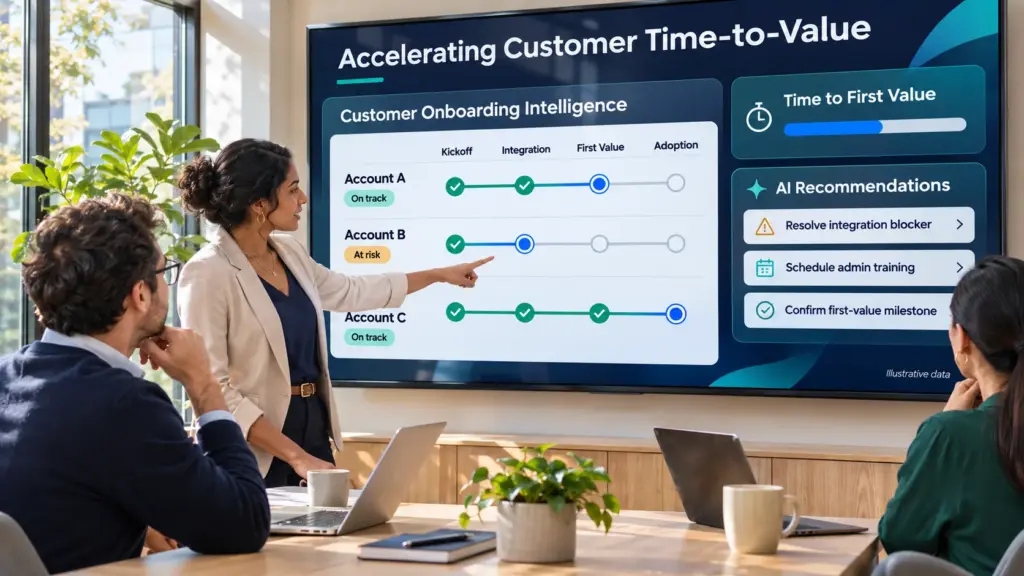
If you’re asking how AI improves customer success in SaaS, start with visibility. A model can watch hundreds of onboarding journeys at once and flag the ones drifting off course. A stalled integration. An admin who hasn’t returned in nine days. A team that finished training but never configured a workflow.
Two changes tend to make the biggest difference.
First, personalized pathways. Rather than pushing every customer through the same checklist, AI adapts the sequence to the role, the integrations chosen, and the pace of the account. A finance admin sees reporting setup first. An operations lead sees workflow configuration.
Second, proactive intervention. When engagement dips, the system alerts the CSM with context, such as which milestone is stuck and what similar accounts did to get past it. The conversation starts with a solution instead of a status question.
Done well, customer onboarding automation removes the repetitive work and leaves the relationship work alone. Scheduling, reminders, document collection, progress tracking, and usage reports can run on their own. Strategy conversations, executive alignment, and difficult trade-offs stay with people.
The teams that get this wrong automate the touchpoints customers value most. The teams that get it right automate the administrative drag around them. If you want to automate enterprise customer onboarding without losing trust, introduce it in stages. Begin with milestone tracking and reminders. Add health scoring next. Bring in recommended actions only after your CSMs trust the signals.
Predictive customer analytics looks at patterns from past accounts to estimate what will happen to current ones. Which customers will hit their go-live date? Which will stall at integration? Which show early signs of churn despite healthy-looking logins?
The value is timing. A risk flagged in week three can be fixed with a call. The same risk discovered at renewal becomes a negotiation. Strong customer success analytics also connects onboarding behavior to long-term outcomes, so you learn which early actions actually predict retention and expansion, not just which ones feel important.
Models are only as good as the data behind them. Clean event tracking, consistent account records, and a clear definition of “activated” matter more than any algorithm choice.
Strong activation with poor stakeholder coverage often points to fragile product adoption, the kind that looks fine until a champion leaves.
You don’t need a perfect platform to improve enterprise SaaS onboarding. Pick one onboarding segment, define the first value milestone, and instrument it. Pilot customer success automation on that segment for a quarter.
The goal isn’t more dashboards. It’s fewer surprises. Faster time-to-value lifts customer adoption, customers renew with confidence, and your team spends its time on growth rather than rescue.
Time-to-value is the span between a customer signing and reaching their first meaningful result with your product. It’s counted in days or weeks, and it’s one of the clearest early predictors of renewal. A short TTV builds confidence and deeper product adoption. A long one invites doubt.
AI tracks every account’s progress at once, spots stalls early, and adapts the onboarding path to each customer’s role and pace. That’s the practical core of AI-driven customer success. Your team gets timely alerts with context, so problems get fixed while they’re still small.
Define the first value milestone before kickoff. Remove avoidable delays like slow security reviews and messy data imports. Then use customer onboarding automation for the routine steps, so your CSMs can focus on stakeholders and blockers.
Track time to first value, activation rate, feature depth, stakeholder coverage, and an onboarding health score. Read them together. Good customer success analytics shows how early behavior connects to retention, not just how busy accounts look in week one.
It compares current accounts with patterns from past ones to estimate who’s likely to go live on time, stall, or churn. With predictive customer analytics, your team gets a warning window and can act before a risk becomes a lost renewal.