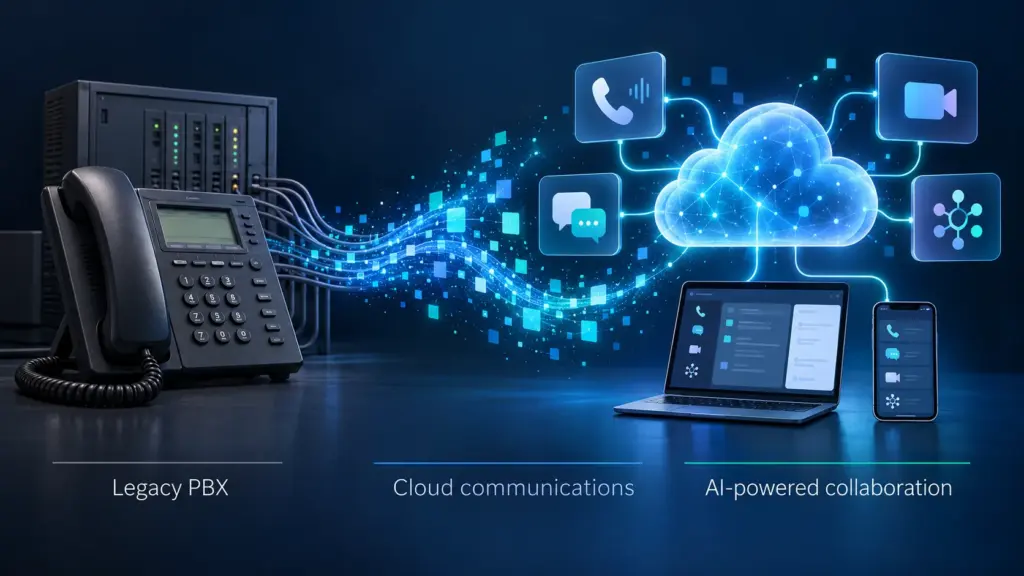
Learn how UCaaS migration replaces legacy PBX systems with AI-driven cloud communications, smarter call routing, and scalable enterprise collaboration.
Your phone system probably works. That’s the problem. It works well enough that nobody questions it, right up until a remote team can’t reach a customer, a carrier retires a line, or a board member asks why support still routes calls by hand. For many IT leaders, legacy PBX replacement has moved from “someday” to this year’s budget conversation. And the change is bigger than swapping hardware. It marks the end of unified communications as a pile of disconnected tools, and the start of a platform that learns.
On-premises PBX hardware was built for a world where everyone sat in the same building and voice was the only channel that mattered. That world is gone. Today’s workforce is spread across offices, homes and time zones, and customers expect to reach you through voice, chat, video and messaging without repeating themselves.
Legacy systems struggle here. Every new site needs new hardware. Every feature needs a vendor visit. Maintenance contracts climb while the equipment ages out of support. Integration with your CRM or collaboration tools is either impossible or held together with custom work nobody wants to own.
Then there’s the cost of standing still. Capacity is fixed, so you either overbuy for peak demand or drop calls during it. Security patches lag. Reporting is thin. For modern enterprise communications, that’s a lot of friction to carry.
The honest comparison of cloud phone systems vs traditional PBX comes down to who carries the burden. With a PBX, you own the hardware, the upgrades, the failover plan and the headaches. With cloud-based phone systems, the provider runs the infrastructure and you manage users, policies and experience from one console.
Here’s what that looks like day to day:
That’s the foundation of broader cloud communications, where voice, video, messaging and contact center share one platform instead of four separate contracts.
Moving to the cloud solves the infrastructure problem. AI solves the experience problem. AI-powered communications add a layer of intelligence that learns from every interaction.
Intelligent call routing is the clearest example. Instead of fixed menus and static rules, the system reads intent, caller history, agent availability and sentiment, then sends the call where it’s most likely to be resolved. Fewer transfers. Shorter waits. Better first-contact outcomes.
Other gains are quieter but just as useful. Live transcription and summaries cut after-call work. Noise suppression clears up remote calls. Analytics flag recurring issues before they turn into escalations. Fraud detection spots unusual calling patterns faster than anyone reviewing logs by hand. Together, these capabilities define real enterprise voice modernization. It’s less about replacing phones and more about turning every conversation into usable data.
If you’re asking how to migrate from legacy PBX to UCaaS, the short answer is: in phases, not over one weekend. A workable path looks like this.
Audit what you have. Inventory lines, numbers, devices, integrations, call flows and contract end dates. Hidden dependencies like fax lines, alarm circuits and lobby phones are the usual surprises.
Define the outcome. Decide what success means: lower cost, better uptime, CRM integration or faster support resolution. Those goals shape vendor selection.
Check network readiness. Look at bandwidth, quality of service, security and failover. Voice over a weak network fails loudly.
Choose a provider. Compare reliability commitments, carrier coverage, compliance posture, AI capabilities and open integrations.
Pilot first. Move one team or site, test call quality and routing, and gather honest feedback.
Port numbers and roll out in waves. Keep the old system live as a safety net until each wave is stable.
Train and tune. Adoption decides ROI. Review analytics monthly and refine routing and automation.
Finance leaders will ask about cost. Fair question. Count the full picture: maintenance contracts, on-site support, hardware refresh cycles, carrier charges, and the productivity lost to outages and manual work. Most organizations find that unified communications delivered as a service lowers total cost while raising capability.
Think of enterprise communications as shared business infrastructure. The stronger argument is risk. An unsupported system is a liability. A flexible platform is a hedge against whatever your workforce looks like in three years.
Traditional telephony isn’t failing overnight. It’s failing slowly, one missed integration at a time. A well-planned legacy PBX replacement gives your teams a platform built for how work happens now, and gives your customers an easier way to reach you. Teams that move to cloud-based phone systems early also find it easier to add AI features later. Start with the audit, pilot small, and let the data guide the rest.
UCaaS, short for unified communications as a service, delivers voice, video, messaging and collaboration from the cloud on a subscription basis. Instead of owning hardware, you use one platform that works across devices and locations.
A PBX is on-premises hardware you buy, maintain and upgrade, and it’s built mainly for voice. UCaaS is hosted by a provider, bundles multiple channels, scales by subscription and updates automatically. One is an asset you manage. The other is a service you use.
Audit your current setup, check network readiness, pick a provider, pilot with one team, then port numbers and roll out in waves. Keep the old system running until each wave is stable.
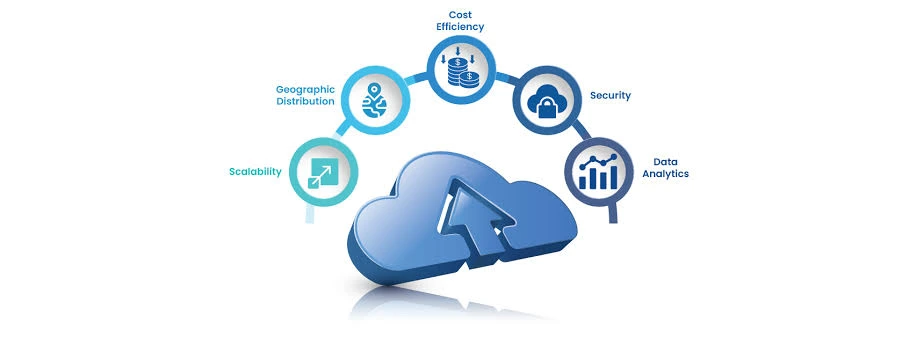
Lower infrastructure costs, faster scaling, built-in redundancy, easier remote work and a single view of every channel. It also opens the door to cloud communications analytics and automation that PBX hardware can’t offer.
AI-powered communications bring smarter routing, live transcription, automated summaries, fraud detection and conversation analytics. The result is shorter waits for customers and less admin work for agents.