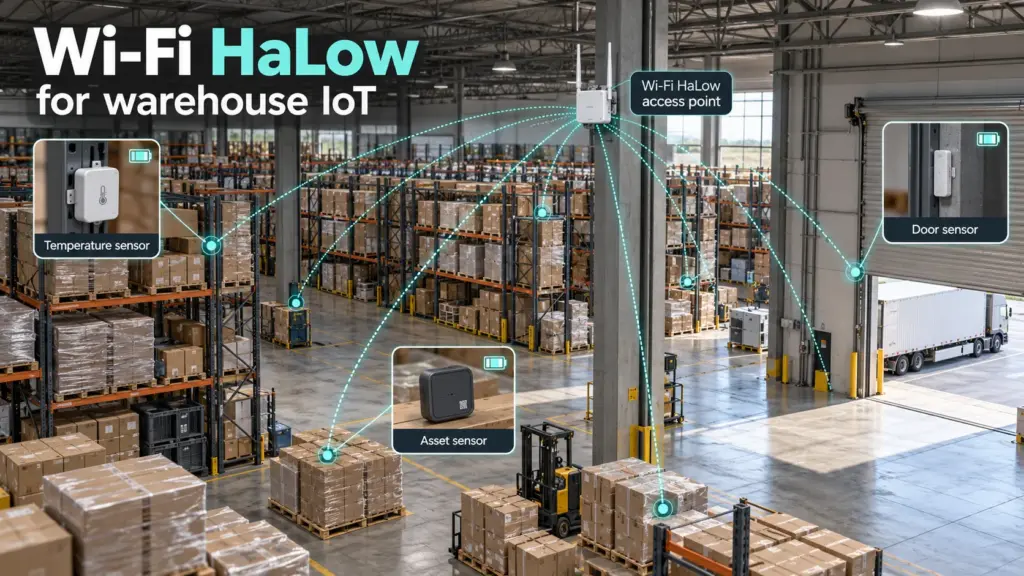
Explore how Wi-Fi HaLow supports long-range, low-power industrial IoT connectivity, helping warehouses connect sensors and extend device battery life.
Most warehouse networks were built for people, not sensors. Handhelds and laptops get the coverage. The temperature probe in the far freezer corner, the vibration sensor on a conveyor motor, the tag on a pallet rack? They get whatever signal is left over.
That gap is where projects stall. Sensors drop offline behind steel racking. Batteries die smonths ahead of schedule. Technicians lose their week climbing ladders to swap cells. A growing number of operations teams are looking at Wi-Fi HaLow to fix both problems at once, and it’s worth knowing why.
Wi-Fi HaLow is the Wi-Fi Alliance’s name for IEEE 802.11ah, a wireless standard built for low-power devices that send small amounts of data over long distances. Regular Wi-Fi runs on the 2.4 GHz and 5 GHz bands. HaLow runs in the sub-1 GHz spectrum, around the 900 MHz band in many regions. Exact frequencies vary by country, so check local rules before planning a rollout.
Lower frequencies travel further and bend around obstacles better. That’s physics, not marketing. The payoff is stronger signal penetration through walls, racking and stacked inventory than a standard access point can manage. Under the right conditions, reach extends to about a kilometer.
So, What is Wi-Fi HaLow in industrial IoT? In short, a quiet, low-power radio layer for sensors that need to reach far.
The trade-off is speed. Data rates run from roughly 150 kbps at the low end to tens of megabits per second with wider channels and multiple streams. You won’t stream video to a handheld this way. But a temperature reading or a door-open alert is a few bytes, so the lower rate rarely gets in the way.
Warehouses are rough on radios. Metal shelving reflects signals. Concrete floors and dense stock soak them up. Cold storage adds its own quirks. That’s the real obstacle for any Warehouse IoT plan. Short-range options like Bluetooth Low Energy or Zigbee need a gateway every few dozen meters, and every gateway means cabling, power and upkeep.
Cellular and low-power wide-area options swing the other way. They reach far, but they often run as a separate network beside your existing one, and recurring per-device fees add up across thousands of nodes.
Battery life is the other half of the problem. A sensor that needs fresh cells every few months isn’t automation. It’s a maintenance chore. That’s why Long-range IoT connectivity only pays off when the battery survives the link.
The main feature is Target Wake Time, or TWT. The access point and the sensor agree on a schedule. The sensor sleeps deeply, wakes at its slot, sends its reading and goes back to sleep. No constant listening. No energy burned on idle radio time. Depending on reporting interval and battery size, devices can run for years between swaps.
Capacity helps too. One access point can associate with up to 8,191 devices, so a single unit can handle sensor density that would swamp a conventional access point. Fewer access points means fewer cables and less to maintain.
And because HaLow is still Wi-Fi, it speaks IP and connects to your wired network the way you already expect. Your team isn’t learning a new stack from scratch.
Think of Warehouse IoT as a lot of small, steady data streams. That’s exactly what HaLow handles well:
All of this sensor telemetry is light on bandwidth and heavy on reliability. That’s the profile HaLow was designed around. Using Wi-Fi HaLow for long-range industrial sensors also keeps the hardware list short: one access point, many probes. The wins show up on the maintenance schedule first, and on the budget soon after. Rolling out long-range wireless sensors across a site with one or two access points, instead of dozens of gateways, changes the cost math quickly.
HaLow also isn’t a replacement for your main network. Robots, scanners and cameras still need Wi-Fi 6 or similar. Treat HaLow as the quiet layer underneath the warehouse automation technology you already run.
Warehouses don’t lack data. They lack reliable ways to collect it from the hard-to-reach corners. Wi-Fi HaLow for IoT gives teams a practical way to cover a large, cluttered floor with fewer access points and to keep batteries alive far longer. It also means no gateway to power and maintain on every aisle. Start with one problem area, like cold storage or a dead zone behind the racking, and measure what changes.
It’s a low-power, long-range version of Wi-Fi designed for IoT devices. It runs below 1 GHz, which lets signals travel further and push through obstacles better than standard Wi-Fi. Think small data, big coverage.
It’s the technical name for the standard behind HaLow. The IEEE writes the Wi-Fi standards, and “ah” marks this amendment for sub-1 GHz, low-power operation. The Wi-Fi Alliance gave it the friendlier HaLow label.
Up to roughly one kilometer under the right conditions. In a warehouse, expect less. Obstructions, antenna choice and data rate all change the result. Strong signal penetration helps, but test on site before committing to a layout.
Mostly through Target Wake Time. Sensors sleep until their scheduled slot, send their sensor telemetry and go back to sleep. Light-weight radio design and low data rates help too, which can stretch battery life to years.
Yes, for the right jobs. Wi-Fi HaLow suits monitoring, tracking and alerting, where payloads are small and coverage matters. It’s not built for video or heavy data, so pair it with a standard Wi-Fi network.