Discover how cloud-based InsurTech platforms automate commercial underwriting, streamline risk assessment, reduce manual work, and improve decision-making.
Ask any commercial underwriter what eats their week, and you’ll rarely hear “risk analysis.” You’ll hear “chasing documents.” Broker emails, ACORD forms, loss runs and schedules of values arrive in different formats and different inboxes. By the time a file is ready for a decision, half the day is gone.
That’s the gap InsurTech platforms are closing. Over the last few years, carriers and MGAs have moved intake, data enrichment and triage into the cloud, so underwriters can spend their time on judgment instead of paperwork. This piece looks at what’s broken in the old model, how automation actually works, and what to check before you invest.
Traditional commercial insurance underwriting runs on manual effort. A single submission for a mid-sized manufacturer can include dozens of attachments. Someone has to open each one, re-key the data into a core system, check it against appetite and guidelines, and then pull third-party information to fill the gaps.
The cost shows up in three places.
None of this is a talent problem. It’s a workflow problem, and workflow problems are exactly what software is good at.
Cloud-based insurance software removes the ceiling that on-premise systems put on speed and scale. New data sources connect through APIs instead of custom builds. Updates roll out without a months-long IT project. And a carrier can absorb a spike in submissions without scrambling for capacity.
Mature cloud insurance platforms also give underwriting, claims and distribution teams one version of the truth. When a loss run is corrected, it’s corrected everywhere. That sounds like a small detail until you’ve spent a Friday afternoon reconciling three spreadsheets.
For teams evaluating B2B insurance solutions, this flexibility matters. Commercial lines are complex, and the platform has to handle property, casualty, specialty and cyber without a separate build for each.
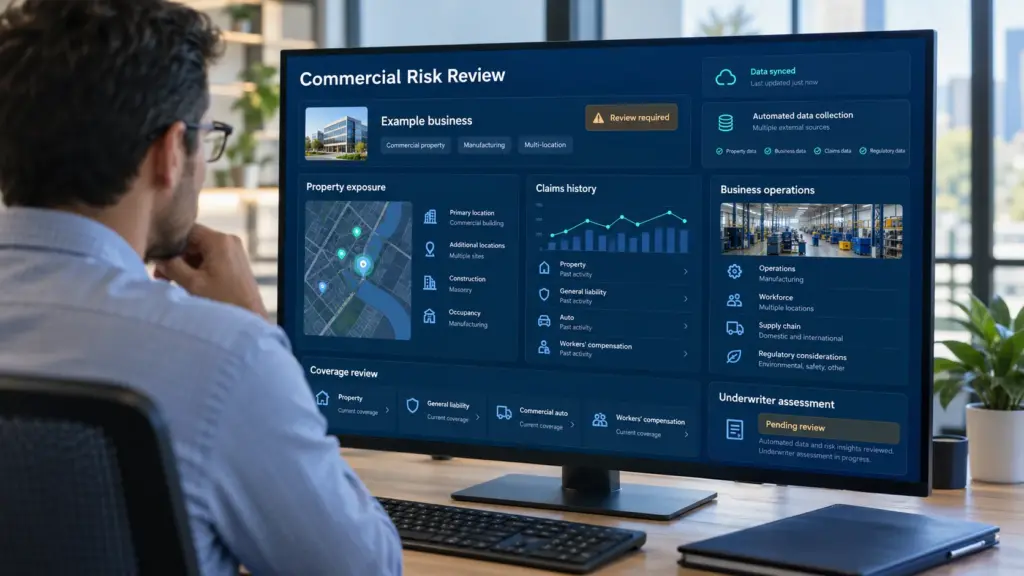
If you’re wondering how to automate commercial insurance underwriting, think of it as a pipeline with four stages.
The human stays in the decision seat. What disappears is the retyping.
AI-powered underwriting gets plenty of hype, so let’s be specific. Its strongest use today is reading unstructured documents, spotting missing information and ranking submissions by their likelihood to bind. It isn’t replacing underwriters on complex accounts. It’s clearing the queue so they can focus on those accounts.
Behind it sits insurance data analytics. Portfolio data, loss history and external signals combine to show where the book is performing and where it’s drifting. That feedback loop lets a team refine its appetite based on evidence rather than gut feel.
This is also how InsurTech improves commercial underwriting over time. Faster intake is the visible win. Better, more consistent risk selection is the one that compounds.
Not every platform delivers on its pitch. Before you shortlist vendors, ask a few practical questions.
Pilot on one line of business first. Measure turnaround time, hit ratio and the share of submissions a human has to touch before you scale.
Conclusion
Underwriting will always rest on human judgment. The shift is in where that judgment gets spent. With the right InsurTech platforms handling intake, enrichment and triage, carriers respond faster, price more consistently and keep their best people on the risks that deserve them.
It’s the process carriers use to evaluate a business’s risk, decide whether to offer coverage and set the terms and price. Underwriters weigh industry, location, financial strength, claims history and exposure before they commit. In commercial insurance underwriting, every account is different, so the work rarely fits a neat template.
Software reads incoming submissions, extracts the key data, enriches it with external sources and scores it against appetite rules. Insurance submission automation handles those early steps, so underwriters review a prepared file instead of raw documents.
It’s a technology system, usually cloud-hosted, that digitizes insurance workflows such as intake, underwriting, policy administration and claims. Carriers, MGAs and brokers use it to cut manual work and move faster. Most InsurTech platforms also connect with broker portals, rating engines and external data providers, which keeps each submission moving.
It reads unstructured documents, flags missing data, ranks submissions and surfaces patterns across a portfolio. AI-powered underwriting doesn’t replace the underwriter. It shortens the path to an informed decision.
Faster deployment, easier integration through APIs, scalability during peak submission periods and a single source of truth across teams. Cloud-based insurance software also receives updates without lengthy IT projects.