Discover how Microsoft Azure AI Foundry empowers enterprises to build, deploy, and govern intelligent applications at scale on a unified AI infrastructure.
AI is moving fast. And for enterprises trying to keep up, the bigger challenge isn’t access to models – it’s managing them. Multiple vendors, fragmented tools, inconsistent governance. It adds up quickly.
Microsoft Azure AI is addressing that directly with Azure AI Foundry: a unified AI development platform built to bring order to enterprise AI operations. Launched in fiscal year 2025 and significantly expanded through 2026, it consolidates model access, agent management, and governance into a single environment on Azure. No more bouncing between disconnected tools.
If your organisation is scaling AI beyond proof-of-concept and into production, Azure AI Foundry is worth understanding. Here’s what it does, how it works, and what sets it apart.
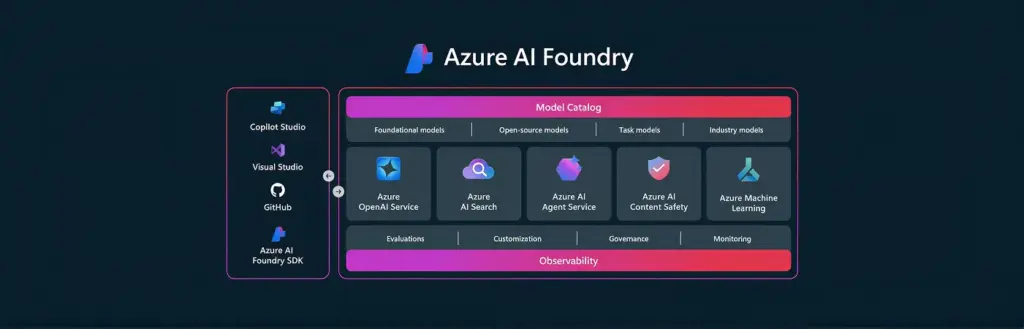
One of the clearest wins with Azure AI Foundry is the breadth of models available. The platform provides access to over 11,000 foundational, open, reasoning, multimodal, and industry-specific models – spanning OpenAI, Anthropic, Meta, Google, xAI, Mistral, Hugging Face, and Microsoft’s own MAI multimodal family.
That’s a significant shift from a locked-in, single-vendor model experience. Teams can select the right model for the right task – balancing cost, performance, and use-case fit – without rebuilding infrastructure each time. Azure is also the only cloud currently offering both Anthropic’s Claude and OpenAI’s GPT models in one place, which matters when you’re operating at enterprise scale and need flexibility.
The Azure OpenAI Service still sits within this ecosystem, but it’s now one part of a much broader catalogue rather than the whole story.
Multi-agent AI is moving from buzzword to business reality, and Azure AI Foundry’s Agent Service is built specifically for it. Teams can develop agents that reason, plan, and act across tools, data, and workflows – and then deploy them directly into a fully managed runtime.
What that means practically: no container images, no Kubernetes clusters, no manual deployment pipelines. Developers working with Microsoft Agent Framework, LangGraph, CrewAI, or other open-source tools can move agents from local development to production without the infrastructure overhead.
Persistent memory and deep Microsoft 365 integration round out the agentic capabilities, enabling context-aware solutions that don’t lose thread across sessions or workflows. For enterprises building intelligent applications that need to operate across departments and datasets, this is a meaningful step forward.
Enterprise AI fails when governance is an afterthought. Azure AI Foundry tackles this through the Foundry Control Plane – a centralised layer that provides end-to-end visibility into agent behaviour, usage, and performance.
Teams get observability across environments, granular security controls, built-in responsible AI guardrails, and compliance tooling – all from a single interface. For regulated industries, this isn’t optional. It’s the baseline. And having it built into the platform, rather than bolted on, reduces the time and cost of getting production deployments through compliance review.
On the developer side, Azure AI Foundry offers a redesigned portal experience with two modes. The classic view suits teams managing complex environments – multiple Azure OpenAI resources, hub-based projects, and Foundry projects in one unified interface. The newer, simplified view targets teams building multi-agent applications without the overhead of managing broader Azure resources.
Both modes support APIs and SDKs across Python, C#, JavaScript, and Java, so integration with existing workflows doesn’t require a full rebuild. The platform is also free to explore – costs apply only when teams actively use models, storage, agents, or other underlying Azure services.
Fine-tuning has also improved significantly. Teams can now work with GPT-5 using reinforcement fine-tuning, and non-OpenAI models like Mistral now have feature parity, which accelerates custom model development without forcing teams toward a single provider.
Azure AI Foundry doesn’t assume your entire stack lives on Azure. Connectors for AWS and GCP let teams leverage best-in-class models and tools regardless of where the rest of their infrastructure sits. The “bring your own model” feature also allows enterprises to connect Foundry-hosted models through AI gateway services like Azure API Management, Mulesoft, and Kong.
That interoperability matters for larger organisations with multi-cloud commitments. It positions Azure AI Foundry as an orchestration layer – not just an Azure-native play.
It’s worth putting Azure AI Foundry in context. Microsoft introduced it as Azure AI Foundry at Ignite 2024, then expanded and rebranded it as Microsoft Foundry at Ignite 2025. That 2025 evolution was more than a rename – it repositioned the platform as a Microsoft-wide AI infrastructure environment rather than an Azure-only offering.
The platform builds on concepts from Azure Machine Learning, Responsible AI tooling, and MLOps best practices. But it extends those foundations considerably – adding enterprise-level model lifecycle management, multi-model governance, and a unified control plane that Azure Machine Learning wasn’t designed to provide on its own.
As a result, the generative AI development workflow that used to require stitching together multiple Azure services now has a coherent home. Teams building conversational AI, autonomous agents, or intelligent enterprise applications don’t have to manage the integration overhead themselves.
Around 74% of companies across industries struggle to scale the value of their AI investments. The problem usually isn’t the models. It’s the lack of a coherent platform to manage them: inconsistent governance, limited observability, and fragmented tooling that slows production deployment.
Azure AI Foundry for enterprises is a direct response to that pattern. By consolidating the build, ground, and govern layers of the AI lifecycle into a single platform, it removes friction at each stage – from model selection through to production monitoring.
There’s also a timing dimension here worth noting. Azure Machine Learning SDK v1 reaches end of support on June 30, 2026. The Assistants API retires on August 26, 2026. Organisations still on those older patterns will need to migrate regardless. Teams planning now, rather than responding to deadlines, will be better positioned to take advantage of Foundry’s architecture rather than simply running migrations.
The entry point is straightforward. The portal is accessible without signing in, and the platform is free to explore. Teams creating projects will need an Azure subscription – but the barrier to getting hands-on is low.
For organisations evaluating the platform, the recommended starting point is Foundry Agent Service for multi-agent use cases and the Foundry Control Plane for compliance and observability requirements. These two components together cover the two most common gaps in enterprise AI deployments: production-grade agent management and governance visibility.
Azure AI Foundry features continue to expand rapidly, with new model releases, fine-tuning capabilities, and image generation improvements landing on a rolling basis. Staying current with the platform roadmap is increasingly part of effective enterprise AI strategy – not a nice-to-have.
Azure AI Foundry is Microsoft’s unified AI development platform on Azure, built to help enterprises design, build, deploy, and govern AI applications and agents at scale. It brings together model access, agentic workflows, and compliance controls into a single environment, consolidating what previously required multiple disconnected Azure services.
The platform operates through three core layers. The model catalogue provides access to thousands of foundational and specialised models from multiple providers. The Foundry Agent Service handles the development and deployment of AI agents. The Foundry Control Plane provides centralised governance, observability, and security across all deployments. Together, they cover the full AI application lifecycle from development through production monitoring.
The key benefits for enterprises include multi-model flexibility without infrastructure complexity, built-in governance and compliance tooling, production-ready agent deployment without the need for container management, cross-cloud connectivity, and a consistent developer experience across SDKs and languages. It reduces both the time and the operational cost of moving AI applications from proof-of-concept to production.
Azure Machine Learning is focused on the traditional machine learning lifecycle – data preparation, model training, and deployment for data scientists who need granular control. Azure AI Foundry is designed for building and scaling generative AI applications using pre-trained and fine-tunable models. While they share some integration points, they serve different primary use cases. Foundry is the stronger choice for organisations working with large language models, multi-agent architectures, and intelligent applications that require rapid iteration rather than custom model training from scratch.
Businesses can use Azure AI Foundry to build conversational AI assistants, deploy autonomous agents that operate across internal systems and data, fine-tune foundation models for industry-specific tasks, and centralise AI governance across teams. With its Azure OpenAI Service integration and support for models from Anthropic, Meta, Mistral, and others, it supports a wide range of enterprise use cases – from customer-facing applications to internal workflow automation – without requiring organisations to rebuild infrastructure for each new project.