Discover how industrial plants can secure remote access, reduce OT vulnerabilities, protect control systems, and strengthen critical infrastructure cybersecurity.
Remote access used to be a convenience for industrial plants. Today it’s a front door, and plenty of those doors are barely locked. An engineer dials in at 2 a.m. to fix a failing pump controller. A vendor connects to tune a turbine. An integrator pushes a firmware update across three sites. Each connection solves a real problem. Each one also widens the attack surface of environments that were never built to face the internet. That tension sits at the heart of modern OT security, and it’s why critical infrastructure security has moved from the plant floor to the boardroom.
Most plants run on equipment designed to last decades, not to be patched monthly. Controllers, RTUs and operator panels often run outdated operating systems, speak protocols that never asked for a password, and can’t be restarted without stopping production. Then remote access gets layered on top. A VPN here, a remote desktop tool there, a vendor’s cellular modem bolted onto a cabinet. Over the years, nobody holds a clean list of who can reach what.
Attackers know this. Stolen credentials, exposed remote desktop services and forgotten vendor tunnels are some of the most common ways into industrial networks. Once inside a flat network, they can move from the business side straight toward the controllers. That’s the point where weak SCADA security stops being a data problem and becomes a physical one: halted production, damaged equipment, safety incidents.
Here’s the part that’s hard to engineer away. You need your vendors. Equipment makers, system integrators and maintenance contractors often require access to keep your plant running. But shared accounts, always-on connections and laptops you don’t manage turn that trust into exposure. The industrial cybersecurity risks from third-party vendors are real because a breach at their end becomes a breach at yours, and you rarely get to see it coming.
IT teams protect data first. Plant teams protect uptime and safety first. That difference shapes everything. You can’t run a scan against a fragile controller, and you can’t patch on a Tuesday afternoon because a vendor said so. Sound industrial control system security has to respect the process it protects, or the plant will find a way around it.
You can’t protect what you can’t see. Start with a living inventory of every asset, every remote pathway and every account that touches the control network. Most teams are surprised by what turns up: forgotten modems, old vendor accounts, direct connections nobody approved.
OT network segmentation limits how far an intruder can travel. Place a demilitarized zone between enterprise and control networks, group assets into zones by function and risk, and let only approved conduits connect them. Frameworks like IEC 62443 and the Purdue model give you a practical blueprint. If one zone is compromised, the rest of the plant keeps running.
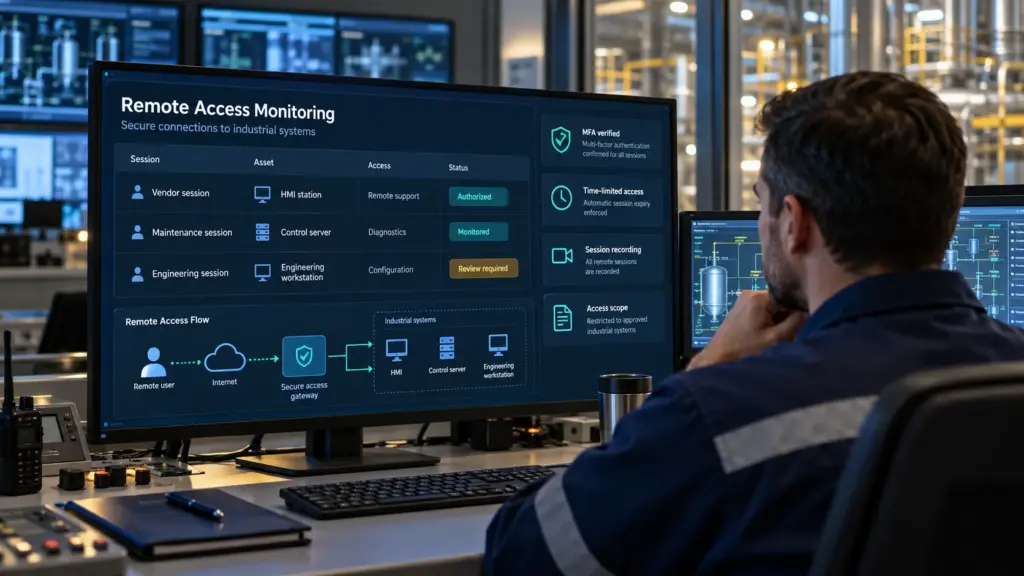
Strong industrial access control is mostly about discipline. Give every person a named account. Require multi-factor authentication. Grant the least access a task needs. Approve vendor sessions for a specific job and a specific window, then close them. Route everything through a brokered gateway, so no one connects directly to a controller, and record sessions so you can review what happened.
If you’re wondering how to secure remote access to industrial plants, a short sequence works well:
Most of these can begin with tools you already own.
Good OT security solutions understand industrial protocols, monitor passively without disturbing controllers, and broker remote sessions with approval and recording built in. They should also fit with your existing IT tooling, so your security operations team sees one picture instead of two. Ask vendors how they behave when the network is degraded, and whether anything has to be installed on a controller. If the answer is yes, keep looking.
Regulation is catching up. Directives such as NIS2 in Europe and sector guidance from agencies like CISA in the United States are pushing operators of energy, water, transport and manufacturing toward stronger controls. Real critical infrastructure protection comes from steady habits: knowing your assets, limiting access, watching the network and practising the bad day before it arrives.
Remote access isn’t going away, and it shouldn’t. The plants that handle it well are the ones that treat every connection as a decision someone made on purpose.
OT security is the practice of protecting the systems that run physical processes, such as controllers, sensors, SCADA platforms and the networks that connect them. The goal is to keep operations safe, available and reliable while blocking unauthorized access and tampering.
Remote access links systems never designed for outside exposure to networks attackers can reach, which weakens critical infrastructure security. Weak credentials, unmanaged vendor tunnels and flat networks let a single compromise spread toward the controllers that run a plant.
Good industrial access control means named accounts with multi-factor authentication, access only for approved tasks and time windows, and every session routed through a monitored gateway. Record sessions, review them, and remove any standing connections nobody can justify.
IT security puts data confidentiality first. OT security puts safety and uptime first. That changes how you patch, scan and monitor, because a disrupted controller can mean a stopped process or a physical hazard rather than just a lost file.
Good SCADA security starts with OT network segmentation, tightly controlled remote access, a current asset inventory, and passive monitoring that understands industrial protocols. Add tested incident response plans so your team knows what to do when something looks wrong.