Discover how AI networking transforms enterprise infrastructure with automation, intelligent network management, cloud connectivity, and scalable performance.
For decades, the network sat quietly in the background. It was the plumbing nobody thought about until something leaked. A router failed, a link saturated, an application slowed to a crawl, and only then did anyone remember the tangle of hardware holding the whole business together. That era is ending. The network has become too large, too distributed, and too critical to run on human reflexes alone.
Enter a new generation of AI Networking. Instead of waiting for engineers to spot a problem, the infrastructure now watches itself, learns its own patterns, and acts before most people notice anything is wrong. This shift is not a marketing gimmick or a distant promise. It is already changing how large organisations design, secure, and operate the systems their revenue depends on.
At its simplest, this is the practice of embedding machine learning and automation directly into the fabric that carries your data. Traditional setups rely on static rules: if X happens, do Y. An intelligent network infrastructure replaces those brittle rules with models that adapt to real conditions.
The system ingests telemetry from switches, routers, firewalls, and endpoints, then builds a living picture of what normal looks like. When behaviour drifts from that baseline, the platform can reroute traffic, throttle a misbehaving service, or flag a threat without a ticket ever being raised. This is what people mean when they talk about Autonomous Networks: environments capable of self-configuration, self-healing, and self-defence.
For a growing company, the appeal is obvious. Human teams do not scale linearly with complexity. Add ten thousand devices and you cannot simply add ten thousand hours of manual oversight. Automation closes that gap.
The pressure did not appear overnight. Several forces converged at once. Hybrid work scattered employees across homes, cafés, and branch offices. Applications migrated to multiple clouds. Traffic volumes exploded, and so did the number of things that could go wrong.
Legacy Enterprise Networking was never built for this. It assumed a fixed perimeter, predictable traffic flows, and a small set of trusted locations. None of those assumptions hold anymore. Engineers found themselves firefighting instead of building, drowning in alerts that mostly turned out to be noise.
AI Networking for Enterprises offers a way out of that reactive loop. By correlating thousands of data points in real time, these platforms separate genuine incidents from background chatter, so teams spend their attention where it actually matters.
It helps to be concrete here, because the promise can sound abstract. How AI Improves Enterprise Networking comes down to a handful of practical capabilities that compound over time.
Predictive Network Monitoring is the first. Rather than reporting a failure after it happens, the platform studies subtle indicators – rising latency, memory creep on a device, unusual retransmission rates – and forecasts trouble hours or days ahead. Maintenance becomes planned rather than panicked.
The second is continuous Network Optimisation. Bandwidth, routing paths, and quality-of-service settings no longer need a quarterly review by a committee. The system tunes them dynamically as demand shifts, keeping critical applications responsive during peak load.
Third is faster resolution. When something does break, automated root-cause analysis narrows a sprawling problem to a probable source in seconds. Engineers arrive with a diagnosis instead of a mystery.
Together these functions turn the network from a cost centre that occasionally embarrasses you into a dependable platform that quietly earns its keep.
You cannot separate performance from protection anymore, and this is where the technology proves its worth most clearly. Network Security has always struggled against the sheer speed of modern attacks. A skilled adversary can move through an environment in minutes, faster than any human analyst can respond.
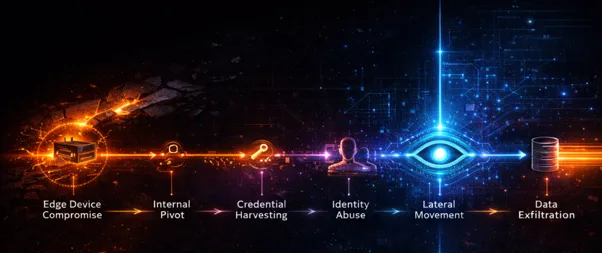
An intelligent platform changes that maths. Because it already models normal behaviour for every user, device, and flow, malicious activity stands out as an anomaly. Lateral movement, credential misuse, and data exfiltration create ripples the system is trained to catch. Suspicious sessions can be quarantined automatically while a person reviews the details.
This does not remove the security team. It gives them a tireless first responder that never sleeps, never gets alert fatigue, and never overlooks the quiet anomaly at three in the morning.
Most enterprises no longer run a single data centre. They run workloads across several providers, plus on-premise systems, plus edge locations. Cloud Networking stitches these islands together, and it is precisely the kind of sprawling, dynamic environment where automation earns its place.
Managing connectivity across multiple clouds by hand is error-prone and slow. An AI-driven layer abstracts that complexity, applying consistent policy and steering traffic along the healthiest path available at any given moment. When a provider has a regional outage, the system adapts rather than waiting for a human to notice the dashboards turning red.
Much of this capability lives under the banner of AIOps – the application of artificial intelligence to IT operations. In a networking context, AIOps ingests logs, metrics, and traces from every corner of the estate, then applies pattern recognition to surface what deserves attention.
The result is a shift in the operator’s job. Instead of staring at raw graphs and guessing, engineers work alongside a system that has already done the correlation. They make judgement calls; the platform handles the grind. That partnership is the practical heart of intelligent operations, and it is why adoption is accelerating across every sector that treats uptime as non-negotiable.
The temptation with any powerful technology is to attempt everything at once. That rarely ends well. The organisations seeing real returns tend to start narrow. They pick one painful, well-understood problem – perhaps recurring outages in a particular region, or chronic latency for a business-critical application – and let automation prove itself there first.
From that beachhead, trust grows. Teams expand the scope as they learn to work with the system rather than around it. Data quality matters enormously in this phase; a model is only as good as the telemetry feeding it, so investing in clean, comprehensive instrumentation pays off long before the fancier features arrive.
The direction of travel is clear. Networks are becoming less like static machinery and more like adaptive organisms that sense, decide, and respond on their own. Human expertise remains essential, but the nature of that expertise is changing – from manual configuration toward supervision, strategy, and exception handling.
Organisations that embrace this transition early will run leaner, more resilient operations. Those that cling to purely manual methods will find themselves outpaced, not because their people are less capable, but because the complexity has simply grown beyond what any team can manage by hand. The rise of Intelligent Network Infrastructure is not a question of if, but of how quickly you choose to move.
It is the use of machine learning and automation to design, run, and defend computer networks. Rather than depending on fixed rules and manual intervention, the infrastructure learns its own behaviour, predicts problems, and takes corrective action with minimal human input.
It improves performance through predictive monitoring, dynamic optimisation, and automated root-cause analysis. Problems are forecast before they cause outages, resources are tuned in real time, and when incidents occur, engineers receive a probable diagnosis in seconds instead of chasing symptoms manually.
It is a networking environment with intelligence built directly into its fabric. Telemetry from every device feeds models that establish a baseline of normal operation, allowing the system to self-configure, self-heal, and self-protect as conditions change.
The main benefits are fewer outages, faster incident resolution, stronger security, and the ability to scale operations without scaling headcount at the same rate. Teams shift from constant firefighting to higher-value planning and design work.
AIOps applies artificial intelligence to IT operations, ingesting logs, metrics, and traces from across the estate to surface what genuinely needs attention. In networking, it correlates signals from many sources so engineers can act on clear diagnoses rather than raw, disconnected data.