Learn how enterprise data contracts prevent breaking schema changes, validate upstream pipelines, and protect downstream analytics from data disruptions.
Every analytics team has lived through this morning. A dashboard that the leadership team relies on shows blanks, a revenue model returns nulls, and the cause turns out to be one renamed column in a source system that nobody mentioned. The upstream team made a reasonable change. The downstream team paid for it. Data contracts exist to close that gap between the people who produce data and the people who depend on it.
A data contract is a formal, versioned agreement between a data producer and its consumers. It describes the structure, meaning, quality expectations and delivery terms of a dataset. In practice, data contracts in analytics cover field names and types, nullability, allowed values, freshness targets, and the named owner who responds when something breaks.
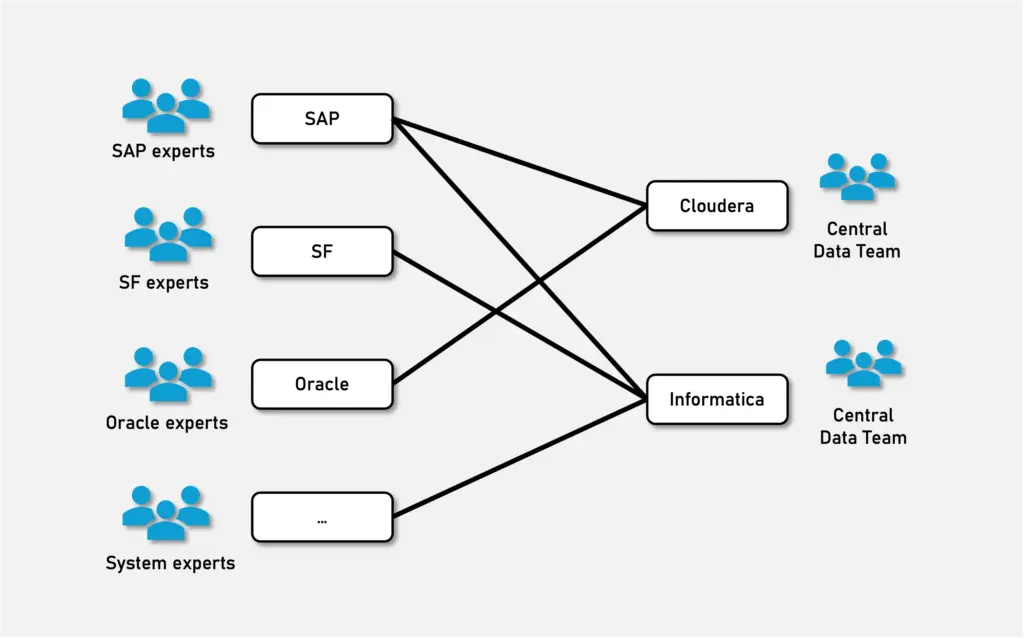
The idea borrows from API design. Nobody expects a payment API to change its response format overnight without notice, yet raw tables and event streams have long been treated far more casually. In large organisations, where dozens of teams share the same sources, that informality becomes expensive. Adopting data contracts for enterprise analytics replaces assumptions with written, testable commitments.
Pipelines are chains. A source table feeds ingestion, ingestion feeds transformation, transformation feeds the warehouse, and the warehouse feeds reports, forecasts and machine learning models. A small change at the start travels a long way. Common culprits include a renamed field, a changed data type, a dropped column, or a shifted unit of measure, such as revenue moving from rupees to paise.
The most damaging failures are silent. A pipeline keeps running while producing wrong numbers, and decisions get made on them before anyone notices. This is why schema evolution needs to be managed deliberately rather than left to chance. Schemas will change as products grow. The goal is not to freeze them but to change them safely.
Schema evolution is the process by which a dataset’s structure changes over time through new fields, retired fields or revised types. What matters is whether a given change is safe for consumers, and that is where schema compatibility comes in:
A good contract states which changes are allowed without notice, which need a deprecation window, and which require a new version of the dataset. That clarity lets producers move quickly on safe changes and slow down only where it counts.
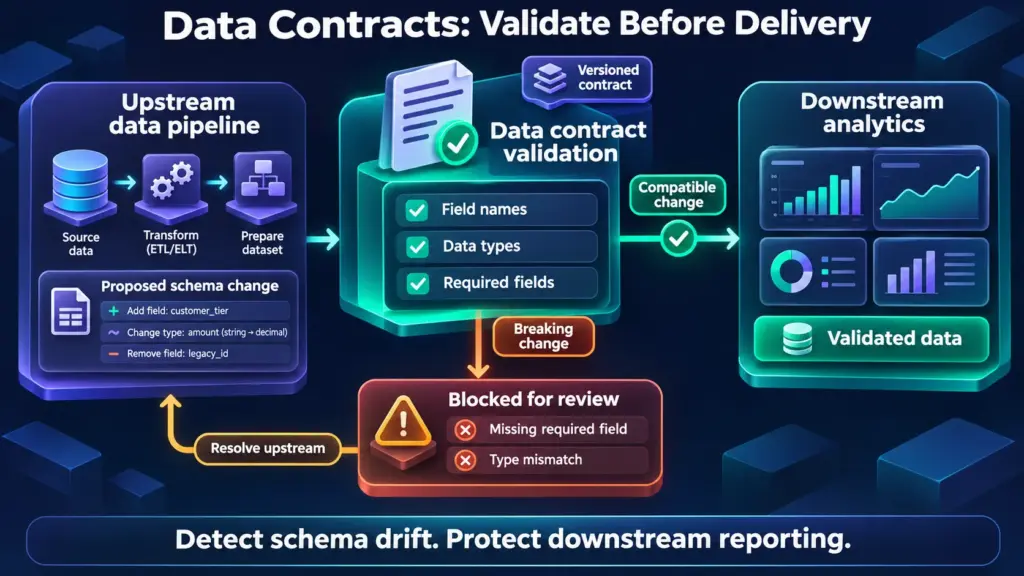
Contracts work because they move the check to the earliest possible point. The flow generally looks like this:
Following data schema validation best practices means validating at both ends: at the source before data leaves, and at ingestion before it enters shared storage. Pair these checks with explicit versioning and a published changelog so every consumer can see what changed and when. Clear ownership is what makes a contract more than a document.
Data contract testing turns the agreement into automated checks. Typical tests confirm that required columns exist, types match, values fall within accepted ranges, keys are unique and records arrive on time. Run inside the producer’s deployment pipeline, these tests fail the build when a change would break a consumer, so the conversation happens before release instead of after an incident.
Consumer-driven testing adds another layer. Each consuming team declares the fields it depends on, and the producer’s pipeline checks every change against those declarations. A column nobody uses can be removed without a long approval cycle, while a column with ten dependents is protected. Sound data validation is not about adding friction. It is about directing attention to where the risk actually sits.
Contracts define what should be true. Data observability shows what is true right now. Together they cover each other’s gaps. Contracts catch declared expectations, while observability surfaces the unexpected, such as a sudden drop in volume, a shift in distribution or a late-arriving table.
Effective data pipeline monitoring tracks freshness, volume, schema changes and quality metrics across every stage, and routes alerts to the named contract owner so someone can act quickly. When a monitor detects a violation, lineage information shows which dashboards and models are affected, which shortens diagnosis from hours to minutes. Teams that pair observability with contracts tend to find problems before business users do, which protects trust in analytics.
Covering every table at once is a common reason programmes stall. A workable approach:
Culture matters as much as tooling. Producers need to see consumers as customers, and consumers need to state their needs precisely.
Breaking changes will never disappear, because businesses change and so do their systems. What can change is how those changes are announced, tested and absorbed. By combining data contracts, disciplined schema management, automated testing and strong monitoring, enterprises can protect downstream analytics and keep decision makers confident in what they see. Start with one critical pipeline, and let the measurable results make the case for the rest of the organisation.
A data contract is a versioned agreement between the team that produces a dataset and the teams that consume it. It records the schema, field meanings, quality rules, freshness expectations and ownership, so both sides know what to rely on.
Engineers define the contract in code, store it in version control and check every proposed change against it during the build. At runtime, the same rules validate incoming data, and violations are blocked, quarantined or flagged to the owner.
Analytics depends on stable, trusted inputs. Contracts stop unannounced upstream changes from silently corrupting reports and models, which reduces incident work and protects confidence in business decisions.
They do not stop schemas from changing. They make changes visible and testable before release. A change that would break a declared consumer fails validation, so the producer must version it, add a migration path or coordinate with consumers first.
It is the gradual change of a dataset’s structure over time, such as added, removed or retyped fields. Managed well, with compatibility rules and versioning, it lets data products grow without disrupting downstream users.