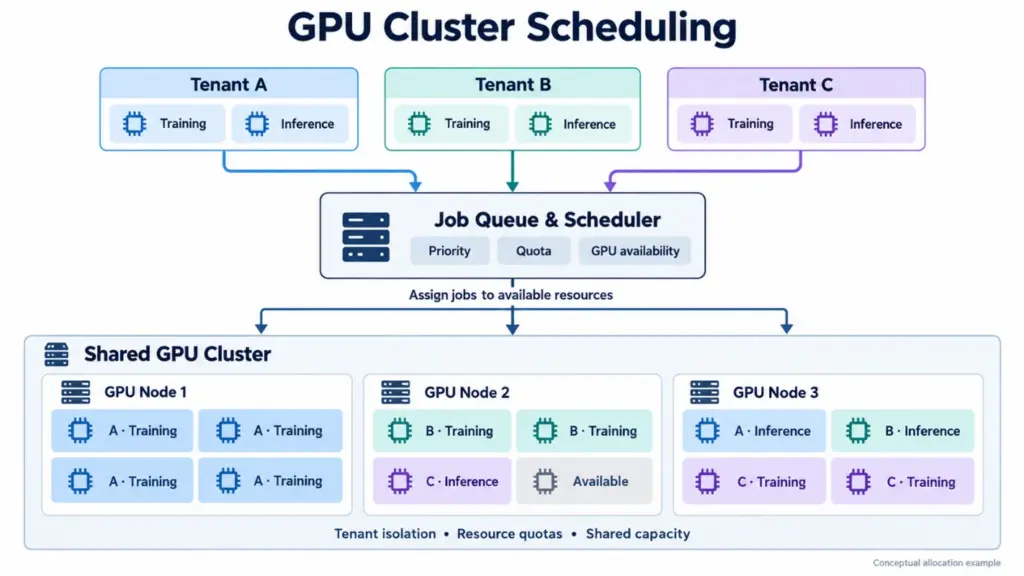
Learn how GPU cluster scheduling improves resource allocation, GPU utilization, and compute efficiency across multi-tenant AI infrastructure.
An idle accelerator costs the same as a busy one. That is the uncomfortable arithmetic behind most AI platform budgets. Teams buy capacity to train and serve models faster, then discover that a large share of the fleet sits reserved and doing nothing while a queue of jobs waits behind it. The hardware is rarely the problem. The logic deciding who gets which card, and for how long, usually is.
GPU cluster scheduling is the process of deciding which job runs on which accelerator, at what time, and under what limits, across a pool shared by several teams. It covers admission, queueing, placement, and reclamation.
It behaves differently from CPU scheduling in ways that matter. Accelerators are usually handed out whole. Device memory cannot be oversubscribed without crashing jobs. Distributed training needs every worker to start together or none at all. A single run can hold hardware for days. Those constraints turn GPU workload management into a placement and fairness problem rather than a simple time-slicing exercise.
Most platform teams watch allocation dashboards and assume allocation reflects work. Chip-level GPU utilization usually tells a different story. The gap comes from a handful of recurring patterns:
None of these are hardware faults. All of them are scheduling outcomes, which is good news, because scheduling is something you can change this quarter.
Good scheduling runs as a loop rather than a one-time assignment.
Admission. A job arrives with a request: device count, memory, expected runtime, priority class, and tenant. The scheduler checks it against quota before it ever enters the queue.
Queueing. Jobs wait in ordered queues. Shorter jobs can backfill into gaps ahead of a large pending run, so a single eight-node request does not freeze the cluster while it waits for room.
Placement. The scheduler picks nodes based on topology, not just free capacity. Workers sharing high-bandwidth interconnect on one node finish faster than workers spread across racks. Bin-packing small jobs onto partially used nodes keeps whole nodes free for large ones.
Gang admission. Distributed jobs start all workers or none. Partial starts burn capacity while the run sits deadlocked waiting for peers that never arrive.
Reclamation. Idle allocations get warned, then preempted. Checkpointed training jobs can be paused and resumed, which makes preemption survivable instead of destructive.
Multi-tenant GPU infrastructure fails politically before it fails technically. One team hoards, another waits, and the platform group ends up arbitrating by chat message.
Explicit workload prioritization replaces that. A workable model gives each tenant a guaranteed floor they can always reach, plus access to idle capacity above the floor that is borrowable and preemptible. Production inference sits in a class that cannot be preempted. Research training sits in a class that can be, with checkpoints required as the price of admission. Exploratory notebooks get short leases that expire.
The effect is that borrowing becomes safe. Teams stop defensively holding hardware they do not need, because they trust they can get it back.
Not every job deserves a whole device. Hardware partitioning splits one accelerator into isolated slices with dedicated memory, which suits small inference endpoints and development work. Time-slicing shares a device across processes without hard isolation, useful for bursty, low-stakes jobs. Choosing the right granularity is often the fastest route to GPU compute optimization, since it removes the mismatch between a small job and a large device. Match the slice size to the job rather than the reverse.
Teams running GPU cluster scheduling for AI workloads tend to converge on similar habits. These GPU workload scheduling best practices are worth adopting early:
You cannot improve GPU orchestration without honest measurement. Four numbers cover most of it: chip-level busy time against allocated time, queue wait by priority class, job completion time from submission to result, and the ratio of useful throughput to raw capacity.
Allocation rate alone flatters the cluster. A fleet reporting full allocation and low device activity is a fleet paying for waiting. Tracking both figures side by side makes the real cost visible to the people who control budgets, which is usually what turns a scheduling project into a funded one.
Pick the smallest fix with the widest reach. In most clusters that is automatic reclamation of idle interactive sessions, followed by quota with borrowing. Neither requires new hardware. Both return capacity within days, and they make the harder work of tuning the scheduler itself easier to justify.
It is the system that decides which job runs on which accelerator, in what order, and for how long, across a shared pool. It handles admission, queueing, placement, and reclaiming capacity from jobs that stop using it.
Jobs submit a request with device count, memory, priority, and tenant. The scheduler checks quota, places the job in a queue, then assigns it to nodes based on available capacity and interconnect topology. Distributed jobs start all workers together. Idle or low-priority jobs can be preempted to free capacity.
Measure chip-level activity rather than allocation, reclaim idle sessions automatically, partition devices for small workloads, bin-pack small jobs to keep whole nodes free, and right-size device requests during review.
It is the assignment of devices, device memory, and runtime to a specific job, governed by tenant quota and priority. Allocation defines what a job may hold, while scheduling defines when it holds it.
Give each tenant a guaranteed floor, allow borrowing of idle capacity above that floor, mark borrowed capacity preemptible, require checkpointing for preemptible jobs, and publish utilization per tenant so allocation decisions are based on evidence rather than negotiation.