Learn how vLLM and PagedAttention optimize GPU memory, improve LLM inference throughput, reduce memory waste, and scale large model serving.
You’ve got the model. You’ve got the GPUs. And somehow your serving stack still chokes at twenty concurrent users. Most of the time, the problem isn’t compute. It’s memory. Teams chasing LLM inference optimization usually tune kernels and batch sizes while a quieter culprit eats half their VRAM. This post walks through where that memory goes, and how vLLM and PagedAttention get it back. For CTOs and platform leads, it’s one of the cheapest wins on the table right now.
A 13B parameter model in 16-bit precision needs roughly 26 GB just for weights. That’s the fixed cost. The variable cost is what hurts. Every request builds a KV cache, the stored key and value tensors for each token processed so far. It grows with every token, and it can’t be freed until the response finishes.
Traditional serving systems reserve one contiguous memory block per request, sized for the longest sequence the model allows. Most requests never get close to that length. You end up with internal fragmentation (reserved but unused space) and external fragmentation (gaps too small to reuse). The research behind vLLM found that earlier systems wasted somewhere between 60% and 80% of KV cache memory this way. That’s expensive silicon sitting idle.
The downstream effect is small batches, weak throughput and climbing inference latency once a queue forms. It’s why GPU memory optimization often matters more than raw FLOPs for serving.
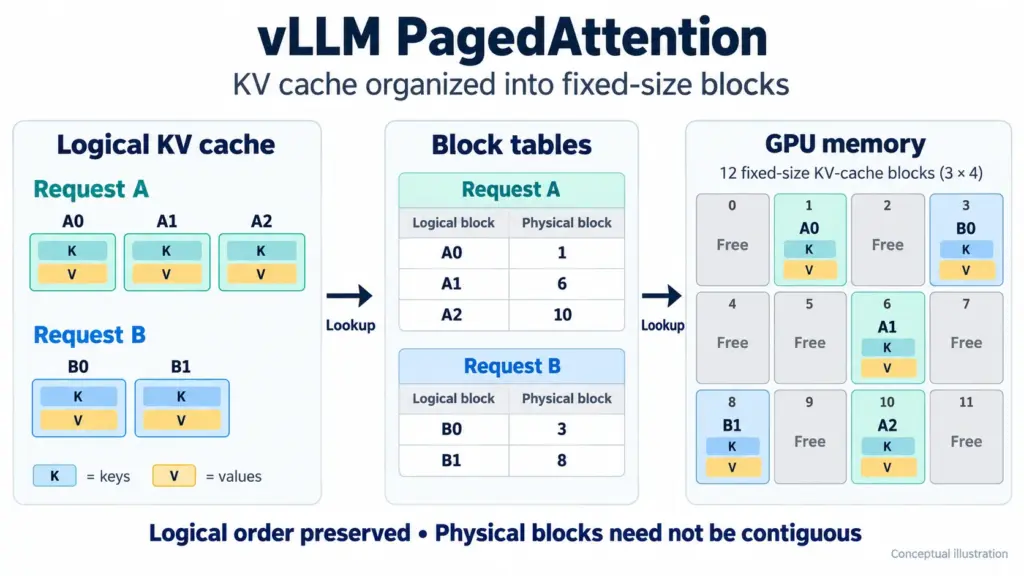
PagedAttention borrows an old idea from operating systems: virtual memory paging. Instead of one big slab per request, the KV cache is split into small fixed-size blocks. Each block holds keys and values for a set number of tokens. A block table maps a sequence’s logical blocks to wherever they physically sit in GPU memory.
Blocks get allocated on demand, as tokens are generated. Nothing is reserved up front for a length the request may never reach. Waste shrinks to the unfilled tail of the last block. Fragmentation mostly disappears, because every block is the same size and any free block will do.
There’s a bonus. Blocks can be shared. When several outputs come from one prompt, as in parallel sampling or beam search, they point to the same physical blocks for the shared prefix, and copy-on-write handles divergence. The same applies to common system prompts across requests. That’s real memory-efficient inference, and it compounds at scale.
Using vLLM for large language model serving is simpler than most teams expect. vLLM is the open-source engine built around PagedAttention. It adds continuous batching, so new requests join a running batch the moment a slot frees up instead of waiting for the whole batch to finish. It also supports tensor parallelism for models that don’t fit on one GPU, quantized weights, and an OpenAI-compatible API server, so existing clients keep working.
A sensible rollout looks like this:
Improving token generation speed for LLMs usually comes down to batching more requests together. Because PagedAttention frees KV cache space, larger batches fit on the same hardware. The original vLLM paper reported two to four times the throughput of earlier systems at similar latency, with bigger gains on long sequences. Your numbers will vary by model and traffic, so measure.
Two things to watch. Throughput and latency pull against each other, so set a latency target first and push batch size up until you hit it. And track time to first token separately from per-token speed, since users feel them differently. Speculative decoding and quantization can help further, but get the memory layer right first.
Model deployment optimization isn’t one switch. Memory management sits next to quantization, routing, autoscaling and observability. A few habits pay off. Track KV cache utilization and preemption rates as first-class metrics. Right-size GPUs for context length, not just parameter count. Benchmark with your real prompt mix. Good AI model serving is boring on purpose: predictable cost per token, predictable latency, no 3 a.m. pages.
If your GPUs look busy but your throughput looks flat, check the KV cache first. PagedAttention fixes the waste at the source, and vLLM makes it practical to adopt. Start small, measure honestly, and let the data decide how far to push GPU memory optimization across your fleet.
vLLM is an open-source engine for serving large language models at high throughput. It handles request scheduling, continuous batching and KV cache management, so you can serve more users per GPU. Teams use it behind chat apps, APIs and internal copilots.
It splits the KV cache into fixed-size blocks and maps them through a block table, much like virtual memory paging in an operating system. Blocks are allocated only as tokens get generated, and they don’t need to sit next to each other in memory. That cuts waste and lets separate requests share common prefixes.
It pairs PagedAttention with smart request scheduling. Blocks are allocated on demand, shared across requests where possible, and freed the moment a sequence completes. Add prefix caching or quantization and you get more memory-efficient inference from the same hardware.
It’s the stored key and value tensors for every token the model has already processed. Reusing them means the model doesn’t recompute attention history at each new step, which noticeably speeds up decoding. The trade-off is memory, since the cache grows with sequence length and batch size.
Fixed-size blocks mean any free block fits any request, so external fragmentation mostly vanishes. On-demand allocation shrinks internal fragmentation to the unused tail of each sequence’s last block. More of the GPU’s memory ends up holding real tokens instead of empty reservations.