Learn how ModelOps and MLOps help enterprises deploy AI models into production with AI lifecycle management, governance, monitoring, and scaling.
You’ve built a machine learning model that works brilliantly in the lab. Your data scientists have tuned it, tested it, and the metrics look stellar. But then reality sets in: moving it to production is nothing like the controlled environment where it was born. The data drifts. Performance degrades. Stakeholders ask why the model that promised 95% accuracy is now stumbling at 78%.
This is where ModelOps enters the conversation.
If you’ve been following the evolution of AI in enterprise settings, you’ve likely heard about MLOps-the practice of operationalizing machine learning workflows. But ModelOps goes a step further. It’s the discipline of managing models across their entire lifecycle, from initial concept through retirement. It’s about governance, monitoring, scaling, and continuous improvement in a production environment where failures aren’t academic exercises; they’re business problems.
The gap between prototype and production has killed countless AI initiatives. ModelOps bridges that gap.
ModelOps is the operational framework for deploying, monitoring, and managing AI models in production at enterprise scale. It encompasses everything from model versioning and performance tracking to governance, security, and regulatory compliance. Think of it as the operational backbone that keeps models performing reliably once they’re live.
Where MLOps focuses on the technical pipeline-data ingestion, training, testing, and deployment-ModelOps widens the lens. It includes model governance (who owns what, who can change it), performance management (is it still delivering value?), and risk mitigation (what happens when it fails?).
In practical terms, ModelOps means:
For enterprise teams, this is non-negotiable. A model that works for a startup’s 100,000-user base behaves very differently at enterprise scale. ModelOps is the infrastructure that handles that complexity.
Here’s what many organisations discover too late: the work of building a model is about 20% of the challenge. The remaining 80% is making sure it stays accurate, compliant, and useful once it’s in production.
Your AI pipeline needs to be automated. Retraining shouldn’t require a team of engineers. Data should flow seamlessly from source systems into your models. Monitoring should be continuous, not annual. When something breaks, you need to know within hours, not weeks.
This is where many Enterprise AI initiatives falter. Teams build impressive models with Generative AI capabilities, deploy them, and then discover they lack the operational infrastructure to maintain them. The model that delivered 92% accuracy on validation data performs differently in production because the input data distribution shifted. There’s no clear process for detecting this drift or retraining the model.
Enterprise Machine Learning at scale demands structured operations. You can’t run it like a research project. You need AI governance, clear accountability, and automated workflows.
Start with versioning and tracking. Every machine learning pipeline change-data updates, feature engineering tweaks, hyperparameter adjustments-should be logged and reversible. This isn’t bureaucracy; it’s survival. When something goes wrong, you need to pinpoint exactly what changed and roll back quickly.
Next, invest in model monitoring. This is different from infrastructure monitoring. You’re watching for performance degradation, data drift, and fairness issues. A model can pass all technical health checks-the server’s running fine, requests are processing-while silently degrading in accuracy. Real-time monitoring catches this.
Third, establish governance. Who can approve a model for production? What’s the review process? What are the compliance requirements? In heavily regulated sectors like financial services or healthcare, this becomes legally mandatory. But even in less regulated industries, clear governance prevents chaos.
Finally, automate your retraining process. Models don’t stay accurate forever. As business conditions shift and data distributions change, your AI governance policies should dictate when and how models get refreshed. Automation means you’re not manually retraining every model every quarter; the system does it based on predefined triggers.
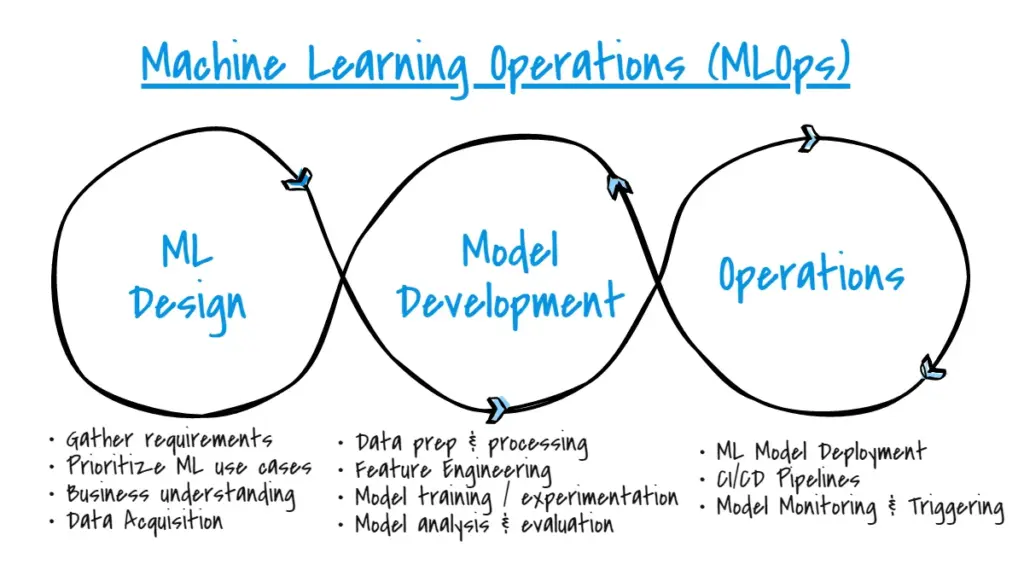
MLOps is the engineering discipline: how do we build, test, and deploy models at scale? It’s about CI/CD pipelines for machine learning, automated testing, and infrastructure.
ModelOps is the operational and business discipline: how do we keep models valuable and compliant in production? It’s about monitoring, governance, cost management, and business impact.
Think of it this way: MLOps gets your model to the finish line. ModelOps makes sure it keeps running and improving after the race is over.
In practice, successful enterprises implement both. Your machine learning pipeline needs MLOps rigor. Your production models need ModelOps oversight.
Generative AI has raised the stakes considerably. Large language models are black boxes that require careful monitoring. They can hallucinate, exhibit bias, and produce outputs that sound confident but are completely wrong. Simply deploying a GPT-based system and hoping it works isn’t an enterprise strategy.
Enterprise AI governance frameworks have become table stakes. Regulators are watching. Customers are asking. Boards are demanding accountability. ModelOps isn’t a luxury; it’s a necessity.
Organizations that master ModelOps best practices and build mature enterprise AI model deployment processes are the ones seeing sustainable value from their AI investments. The others are cycling through failed experiments and abandoned projects.
Start small. Pick one model. Implement proper versioning, monitoring, and governance. Get that flywheel working. Then scale it across your portfolio. As your AI pipeline matures, you’ll find that ModelOps isn’t overhead-it’s what enables sustainable AI.
The future of enterprise AI isn’t about bigger models or more data. It’s about operational excellence. It’s about having the discipline to manage models like you’d manage any other critical business asset.
That’s ModelOps.
ModelOps is the operational framework for managing AI models throughout their entire lifecycle in production. It encompasses deployment, monitoring, governance, performance tracking, and compliance management. Unlike MLOps, which focuses on the technical pipeline and engineering processes, ModelOps extends into business governance, regulatory compliance, and model performance accountability at enterprise scale.
MLOps focuses on the technical engineering side: building, testing, and deploying machine learning models through automated pipelines. ModelOps covers the operational and business side: monitoring model performance, managing governance, ensuring compliance, and maintaining model value in production. MLOps gets models to production; ModelOps keeps them running reliably and delivering business value.
Most AI projects fail because teams focus on model accuracy during development but neglect operational requirements in production. Common causes include: data drift that degrades model performance over time, lack of monitoring to detect issues, unclear governance and accountability, insufficient retraining processes, and regulatory compliance gaps. Without proper ModelOps practices, even accurate models struggle in real-world conditions where data distributions and business contexts shift.
Successful enterprise AI deployment requires: establishing clear governance frameworks and approval processes; implementing comprehensive model monitoring to detect performance degradation and data drift; automating retraining workflows based on predefined triggers; versioning all model components for auditability and rollback capability; ensuring regulatory compliance and fairness testing; and building cross-functional teams that combine data science, engineering, and business expertise. ModelOps provides the operational structure that makes this systematic and sustainable.
Key benefits include: reduced time from model development to production value; early detection of model degradation and data drift; faster incident response and model rollback when issues occur; improved regulatory compliance and risk management; lower operational costs through automation; increased model reliability and consistency; better accountability through clear governance; and sustainable competitive advantage through managed AI portfolio optimization.