Learn how to implement Retrieval-Augmented Generation (RAG) with databases, vector search, and enterprise RAG architecture for accurate AI applications.
Ask any large language model a question outside its training data, and it will still answer. Confidently. Sometimes correctly. Often not. That gap between “sounds right” and “is right” is exactly what Retrieval-Augmented Generation (RAG) was built to close, and the part most teams get wrong is thinking of it as a prompting trick instead of a data problem.
The real work of RAG doesn’t happen in the prompt. It happens at the database layer, in how you store, index, and retrieve information before the model ever sees it.
Retrieval-Augmented Generation (RAG) is a method that pairs an LLM with an external knowledge source, so the model retrieves relevant information at query time instead of relying only on what it memorized during training. Instead of guessing from static parameters, the model pulls in current, specific, and verifiable content, then generates its answer grounded in that content.
Think of it as the difference between an employee answering from memory versus one who checks the company wiki first. Both might sound confident. Only one is reliably accurate.
For enterprise use cases, this matters more than it sounds. Internal policies change. Product catalogs update. Compliance rules shift by quarter. A model that can’t retrieve current information is a model that will eventually give someone the wrong answer at the wrong time.
A lot of early RAG tutorials focus on prompt templates: how to phrase the instruction, how to format the retrieved context, how to structure the final call to the model. That’s the easy 20%.
The hard 80% is RAG architecture at the storage layer. Specifically:
Get this wrong, and no amount of prompt engineering fixes it. Garbage retrieval in, garbage generation out.
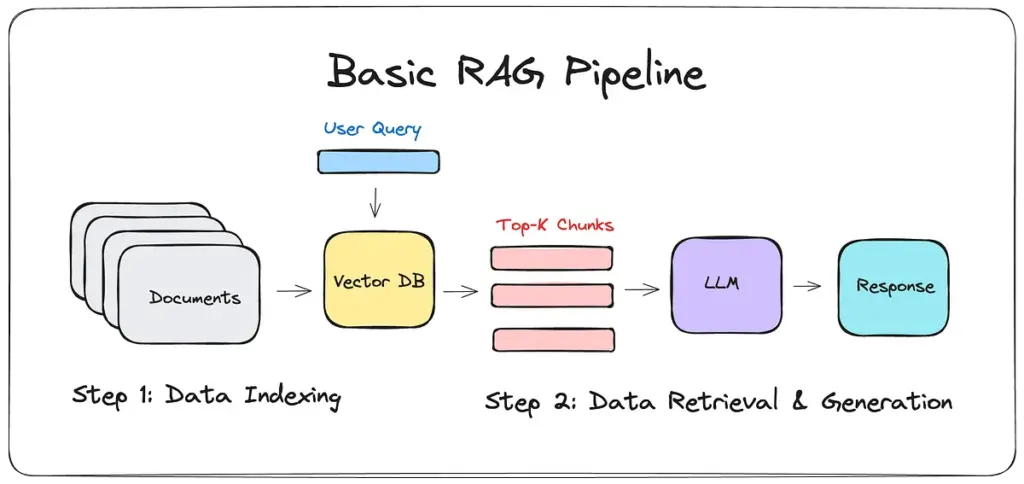
Here’s the flow, stripped down to its actual mechanics:
This is where the phrase “database for RAG” starts to mean something specific. Not just any database works. You need one that can perform similarity search across millions of vectors in milliseconds, without falling over under production load.
A RAG database, more commonly called a vector database, is purpose-built to store and search embeddings efficiently. Traditional relational databases are excellent at exact matches: find the row where customer ID equals X. They’re not built for “find the 10 records that mean something similar to this query,” which is a fundamentally different kind of search.
Vector databases solve this with indexing structures designed for approximate nearest-neighbor search, letting them scan enormous datasets and return semantically relevant matches fast enough for real-time applications.
Three reasons come up constantly in production systems:
If you’re wondering how to implement RAG inside an existing enterprise stack, the sequence generally looks like this:
Done right, enterprise RAG turns an LLM from a confident guesser into a grounded, verifiable assistant. It’s not a prompt hack. It’s an investment in the data infrastructure underneath the model, and it’s usually the difference between an AI pilot that impresses in a demo and one that survives contact with real, messy, ever-changing enterprise data.
The prompt gets the credit. The database layer does the work.
It’s a technique that connects an LLM to an external knowledge source, so it retrieves relevant, current information at query time instead of relying only on what it learned during training.
Content is chunked, converted into vector embeddings, and stored in a database optimized for similarity search. When a query comes in, the system retrieves the closest matching chunks and hands them to the model as context.
It’s typically a vector database, purpose-built to store embeddings and run fast similarity search across large, high-dimensional datasets, something traditional relational databases weren’t designed to do.
They deliver fast semantic search at scale, match content by meaning rather than exact keywords, and integrate well with the update-heavy pipelines enterprise systems require.
Start by auditing your content, choosing a chunking strategy, picking an embedding model, setting up your retrieval infrastructure, and testing retrieval quality separately from generation quality before scaling up.