Explore AI-powered enterprise knowledge management to enhance enterprise search, collaboration, knowledge sharing, and operational efficiency.
Every large organisation has the same quiet problem. Somewhere inside the business, the answer to a critical question already exists. It lives in a document someone filed eighteen months ago, in a Slack thread no one can locate, in the notes from a project that wrapped before half the current team was hired. The knowledge is there. Getting to it is another matter entirely.
This is the gap that modern knowledge management has always promised to close. The question in 2026 is not whether organisations need it – they do – but whether the tools they have been using are remotely equal to the scale of the problem.
Enterprise knowledge management is the discipline of capturing, organising, sharing, and maintaining the collective knowledge of an organisation so that the right people can access the right information at the right time.
A well-functioning knowledge management system does more than store documents. It connects institutional memory to daily workflows. It makes the expertise of a senior engineer accessible to a new hire. It ensures that decisions made in one business unit do not have to be rediscovered from scratch in another. Done properly, it is one of the highest-leverage investments an organisation can make in its own operational efficiency.
The challenge is that most legacy approaches were not built for the scale or complexity of modern enterprise environments. Search functions return too many results and too few useful ones. Taxonomies break down as teams grow. Content becomes stale faster than it gets updated. The knowledge repository accumulates volume without gaining coherence.
The average enterprise knowledge base contains tens of thousands of documents spread across wikis, intranets, shared drives, collaboration platforms, and ticketing systems. The volume is not the problem. The problem is discoverability.
Traditional enterprise search relies on keyword matching and manually assigned metadata. A user searching for “client onboarding process” will not find the document titled “New Account Setup – Phase One Workflow” even if it contains exactly what they need. The language does not align. The metadata is incomplete. The result is that employees spend a significant portion of their working week searching for information they cannot find and then recreating or requesting it from colleagues who have better things to do.
This is where AI knowledge management changes the picture fundamentally.
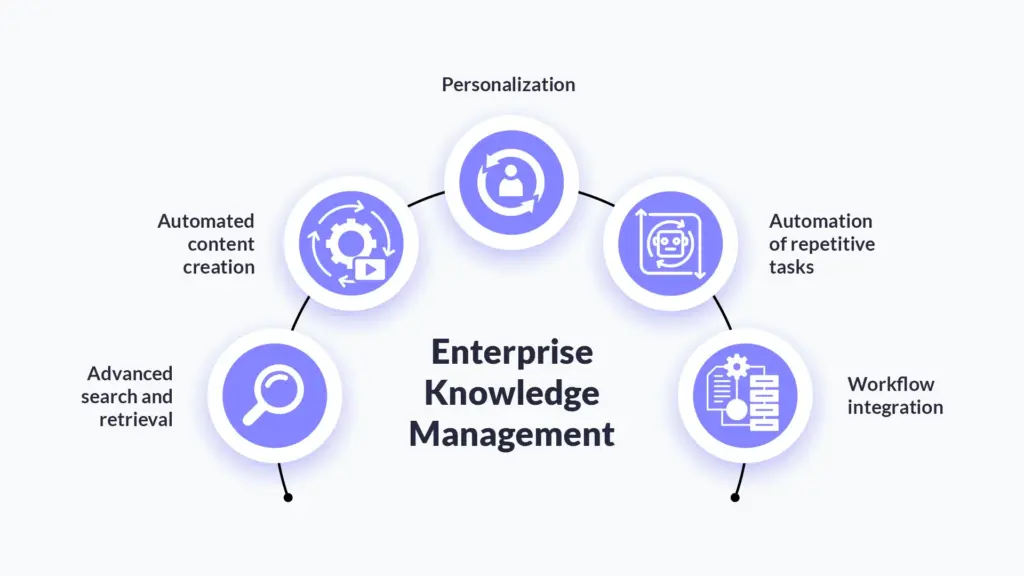
AI does not simply make search faster. It makes search smarter. Rather than matching words, modern AI systems understand intent. They interpret what a user is actually trying to accomplish and surface content that addresses that intent, regardless of how it is labelled or where it is stored.
Semantic search is a core component of this shift. Instead of scanning for exact keyword matches, semantic search analyses the meaning behind a query and retrieves results based on conceptual relevance. A user asking “how do we handle enterprise client renewals” will surface contract management guides, renewal playbooks, and relevant account notes – even if none of those documents use the exact phrase from the query.
Beyond retrieval, AI contributes to knowledge creation and maintenance. Language models can summarise long documents into digestible formats, flag outdated content for review, identify gaps based on frequently unanswered queries, and auto-tag content as it enters the system. This dramatically reduces the administrative overhead that causes most knowledge management programmes to degrade over time.
The organisations seeing the strongest results from AI-powered knowledge tools are not the ones that simply adopted a new platform. They are the ones that approached it as a knowledge management strategy with clear goals, governance structures, and usage standards.
A few principles tend to separate effective programmes from underperforming ones.
Start with structure before scale. Feeding an AI system a disorganised repository produces disorganised outputs. Before deploying intelligent knowledge management tools, organisations benefit from auditing what exists, what is accurate, and what can be retired. The quality of inputs shapes the quality of what gets surfaced.
Integrate with existing workflows. The most effective deployments are not separate destinations employees have to remember to visit. They surface relevant knowledge inside the tools teams already use – inside the CRM, the project management platform, the support ticketing system. Friction is the enemy of adoption.
Treat knowledge as a living asset. Content governance is not optional. Assigning ownership, setting review cycles, and building feedback loops into the system ensures that what gets surfaced remains accurate and trustworthy over time.
The downstream benefits of sound enterprise knowledge management practice are substantial. Customer-facing teams resolve issues faster because they can find accurate product information without escalating. Onboarding timelines shorten because new hires can access institutional context independently. Compliance teams spend less time hunting for documentation because it is consistently structured and retrievable.
There is also a less-discussed benefit: the reduction of knowledge silos. When teams operate in informational isolation, they make redundant decisions, repeat past mistakes, and miss opportunities to build on each other’s work. A functioning intelligent knowledge environment breaks down those walls without requiring behavioural change mandates from leadership.
AI improves enterprise knowledge management by enabling semantic search, automating content tagging and summarisation, identifying knowledge gaps, and surfacing relevant information based on user intent rather than exact keyword matches. This makes organisational knowledge significantly more accessible and reduces time spent searching for information.
An enterprise knowledge management system is a platform or set of tools that enables organisations to capture, organise, store, and share institutional knowledge at scale. Modern systems integrate AI capabilities to improve discoverability, automate maintenance, and connect knowledge to the workflows where it is needed.
AI-powered knowledge management reduces information retrieval time, improves search accuracy, automates content governance tasks, shortens employee onboarding, and helps break down knowledge silos between teams. It also enables organisations to identify documentation gaps and maintain a more accurate and up-to-date knowledge base.
Enterprise search is the ability to query and retrieve information from across an organisation’s internal content systems – including wikis, intranets, shared drives, emails, and collaboration tools. AI-powered enterprise search goes beyond keyword matching to understand user intent and surface contextually relevant results.
A modern knowledge management strategy should begin with a content audit, establish clear ownership and governance processes, integrate knowledge tools into existing workflows, and use AI to automate tagging, summarisation, and gap identification. Treating knowledge as a living asset rather than a static archive is essential for long-term effectiveness.