Learn how data mesh governance enables domain-driven ownership, federated standards, data quality, and accountability across enterprise data teams.
Enterprise data teams are under more pressure than ever. Pipelines are sprawling, ownership is murky, and centralized data teams are bottlenecked trying to serve every domain at once. The old playbook, where one team governs everything, just doesn’t hold up at scale. That’s why data governance in modern enterprises is shifting toward a fundamentally different model: data mesh.
Data mesh doesn’t just redistribute data. It redistributes accountability. And that shift, from centralized control to domain-driven data ownership, is where the real governance challenge begins.
Data governance in a mesh architecture is the operating model that sets the rules, standards, and accountability structures across a distributed data ecosystem. Unlike traditional governance, where a central team owns policy and enforcement, data mesh governance works through a federated model. Each domain team owns its data, but every team plays by the same rulebook.
This is what makes it complex, and what makes it powerful. You get the autonomy of decentralized ownership without losing enterprise-wide consistency. The key is getting the governance scaffolding right.
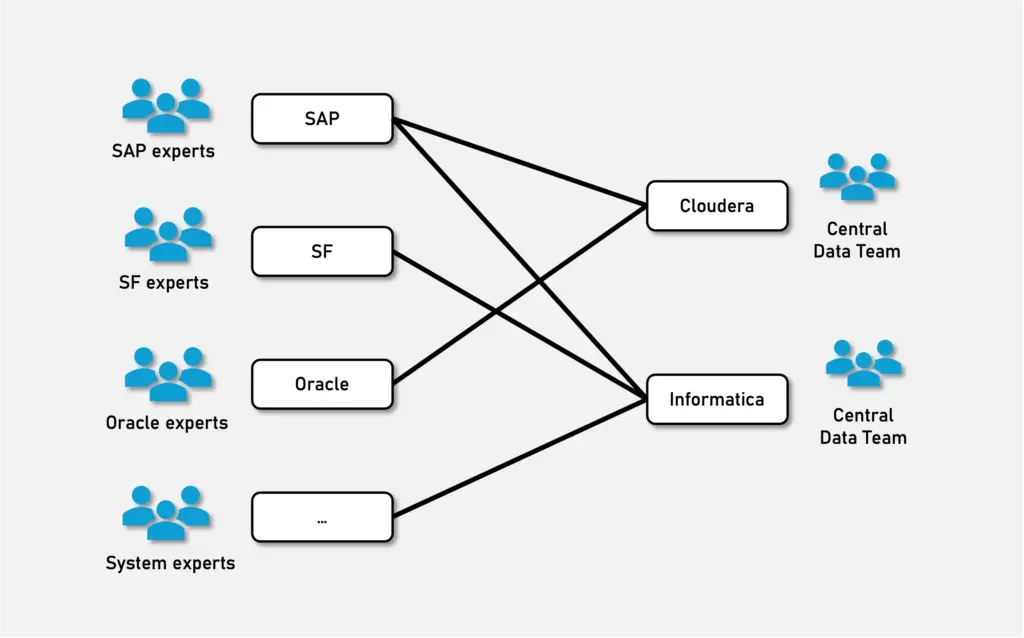
Centralized data architectures create a familiar problem. The data engineering team becomes a dependency for everyone. Product teams wait. Insights get delayed. Quality suffers because the people closest to the data aren’t the ones managing it.
Domain-driven data ownership flips this. Each business domain, whether that’s sales, finance, logistics, or customer success, takes ownership of the data it generates and consumes. The sales domain knows its pipeline data better than any central team does. Finance understands its ledger structures. Domain-oriented ownership means the people with the deepest context are also the ones responsible for quality, access, and data lineage.
This isn’t just an architectural choice. It’s an organizational one. And it requires clear definitions of what ownership actually means.
Here’s the tension every enterprise runs into: if every domain governs itself independently, you end up with inconsistency. Different schemas, conflicting definitions, incompatible access policies. The mesh becomes a mess.
Federated data governance solves this by separating what domains control from what the enterprise mandates. Domains own their data products. The enterprise owns the standards. Federated governance for data mesh architecture works through a central governance plane, often called the data governance council or platform team, that sets interoperability requirements, security baselines, and compliance guardrails. Domains operate freely within those guardrails.
Think of it like franchise governance. Individual locations run their own operations but follow brand-wide standards. Data stewardship at the domain level becomes the execution arm of enterprise-wide policy.
One of the most practical tools in data governance frameworks is the data contract. A data contract is a formal agreement between a data producer and its consumers. It defines the schema, SLAs, quality standards, and update frequency for a given data product.
Data contracts make implicit expectations explicit. They force domain teams to think about their data as a product, not just a byproduct of their operations. And they give downstream consumers something to rely on. When a data contract is broken, such as when a schema changes without notice or quality drops below threshold, there’s a clear accountability trail.
This is where data product management becomes a real discipline. Managing a data product means maintaining its contract, monitoring its quality, and iterating on it the way a product team iterates on software. The mindset shift is significant, but the payoff is real.
Domain-driven data ownership in data mesh needs a human anchor in each domain. That’s the data product owner. This person is responsible for the full lifecycle of a domain’s data products, from defining what gets published to ensuring data lineage is traceable and documentation is current.
The data product owner sits at the intersection of business context and technical execution. They work with engineers to ensure pipelines are reliable, with governance teams to ensure compliance, and with consumers to understand what’s actually useful. They’re not necessarily technical, but they have to understand the data deeply enough to make product decisions about it.
Data stewardship at this level is less about policing and more about enabling. The best data product owners treat their domain’s data as a service to the rest of the organization.
Implementing federated data governance across an enterprise isn’t a one-time project. It’s an ongoing operational commitment. A few things that make it work in practice:
Start with clear domain boundaries. Governance breaks down when ownership is ambiguous. Define which team owns which data before you build anything.
Standardize metadata and data lineage practices early. If domains track lineage differently, you’ll lose the ability to trace data across the mesh.
Invest in the self-serve platform layer. Data product management only scales if domain teams have tooling to publish, document, and monitor their products without heavy infrastructure support.
Treat data contracts as living documents. They need versioning, change management processes, and clear deprecation policies.
And finally, build a governance community of practice. Data governance in a mesh model is as much cultural as it is technical. Domain teams need to see governance as shared infrastructure, not central control.
Data mesh without governance is just distributed chaos. But federated data governance done right gives enterprises the best of both worlds: domain agility with enterprise-grade accountability. Domain-driven data ownership puts responsibility where it belongs, closest to the source. Data contracts make quality a commitment, not an assumption. And data product management turns raw data into something the rest of the organization can actually rely on.
The shift is real. But so are the results.
Data mesh governance is the federated model for managing data standards, accountability, and quality across a distributed, domain-owned data architecture. It balances domain autonomy with enterprise-wide policy enforcement.
Data mesh assigns data ownership to the business domains that generate and use the data. Each domain manages its own domain-driven data ownership responsibilities, including quality, access, and data lineage, rather than delegating those to a central team.
Federated data governance is an approach where domain teams govern their own data products while following centrally defined standards and interoperability requirements. It allows autonomy without sacrificing enterprise consistency.
In a data mesh, individual business domains own their data. Domain-oriented ownership means the teams closest to the data, such as sales, finance, or operations, are accountable for its quality, availability, and governance.
A data product owner manages the lifecycle of a domain’s data products. This includes maintaining data contracts, ensuring data stewardship standards are met, and acting as the primary point of accountability for data product management within their domain.