Discover why CMO and CFO alignment is critical for pipeline accountability and revenue growth. Learn RevOps strategies that drive measurable results.
Pipeline accountability refers to the shared ownership of revenue generation across marketing, sales, and finance functions. It’s the framework that turns scattered efforts into coordinated action-where every stakeholder owns a piece of the revenue pie and tracks it obsessively. When implemented properly, pipeline accountability creates transparency across your go-to-market engine and eliminates finger-pointing when targets miss.
The truth is this: most B2B organizations still run marketing and finance in separate universes. The CMO launches campaigns, sales chases deals, and the CFO watches cash flow without seeing how the pieces fit together. But that’s a recipe for waste. Pipeline accountability fixes that by creating a single source of truth where every dollar spent and every lead generated has a clear path to revenue.
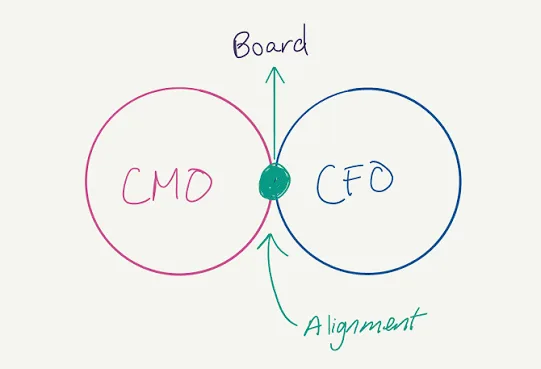
The business landscape has shifted. It’s no longer enough for the CMO and CFO to exchange pleasantries at quarterly business reviews. They need to be locked in alignment on revenue goals, and that alignment has to start with understanding pipeline management from both a marketing and finance lens.
Here’s why this matters: Revenue marketing requires investment, and that investment only makes sense when you can prove it drives results. The CFO needs visibility into how marketing ROI translates to actual pipeline contribution. The CMO needs clarity on budget allocation and the financial parameters that make campaigns worth running. Without this alignment, budgets get slashed, campaigns get deprioritized, and growth stalls.
The rise of B2B marketing strategy has made this alignment non-negotiable. Modern B2B buyers have a 70% of their purchase journey complete before they even speak to sales. This means demand generation happens almost entirely in marketing’s domain initially, yet finance and sales often don’t understand the mechanics. When CMO and CFO alignment improves, three things happen: budgets get defended better, pipeline quality improves, and revenue forecasts become more predictable.
Most companies track metrics in silos. Marketing looks at cost per lead. Sales tracks win rates. Finance watches cash. But nobody’s connecting these threads to show revenue attribution-which campaigns actually moved the needle on closed deals.
Revenue forecasting becomes a guessing game without this visibility. The CFO can’t confidently project next quarter’s revenue if they don’t know which marketing ROI levers actually drive deals through the pipeline. The CMO can’t justify marketing spend if they’re not tied to revenue outcomes.
This is where pipeline management enters the conversation. It’s the practice of tracking opportunities from first touch through close, with clear attribution back to the source. When done right, it transforms marketing ROI from a vague metric into a concrete business outcome that finance can bank on.
The most forward-thinking organizations are adopting Revenue Operations-often called RevOps. RevOps is the structural alignment of marketing, sales, and finance around a single mission: predictable revenue growth. It’s not a department; it’s a philosophy.
Under RevOps, the CMO and CFO work together to define what “good” looks like. They agree on SLAs between marketing and sales. They jointly own the pipeline management metrics that matter. They make decisions on budget allocation based on actual pipeline management data, not hunches.
The CFO cares about revenue forecasting accuracy and cash flow. The CMO cares about campaign performance and brand impact. RevOps says: you both get to care about those things, but you also both own revenue attribution and pipeline health. That shared accountability changes everything.
Let’s be real: tracking too many metrics is as bad as tracking none. When CMO and CFO alignment improves, organizations get selective about what they measure. Here’s what moves the needle:
When the CMO and CFO align on these five metrics, suddenly everyone’s pulling in the same direction. Marketing optimizes campaigns for quality over volume. Sales focuses on the leads that close. Finance gets predictable revenue forecasting data.
The era of pipeline accountability isn’t just about better metrics. It’s about cultural shift. It’s about moving from a model where marketing “generates leads” that sales “hopefully converts” to a model where both teams own the outcome together.
This shift requires honest conversation. The CFO needs to ask: What’s the real cost of acquiring customers through different channels? The CMO needs to ask: What’s the actual demand in the market, and how do we reach it efficiently? Together, they ask: How do we build pipeline management systems that give us confidence in our revenue forecasting?
B2B marketing strategy has matured enough that this is now possible. You don’t need fancy AI to do this-you need alignment, clean data, and shared accountability.
The organizations winning in 2026 aren’t the ones with the biggest marketing budgets. They’re the ones where the CMO and CFO actually talk to each other, where pipeline management is a shared discipline, and where every campaign ties back to revenue growth outcomes.
Start small. Pick one campaign. Track it end-to-end from first touch to closed deal. Measure the marketing ROI. Let the data speak. Then expand from there.
CMO and CFO alignment isn’t a one-time initiative-it’s the foundation of sustainable revenue growth in B2B.
Pipeline accountability is the practice of shared ownership over revenue generation across marketing, sales, and finance functions. It means each department understands its role in moving opportunities through the pipeline and takes responsibility for measurable outcomes. Rather than marketing being judged on leads alone or sales on closed deals alone, pipeline accountability creates transparency about how activities in one function affect results in another. This alignment eliminates gaps where deals fall through and ensures budget decisions are backed by data about what actually drives revenue growth.
When CMO and CFO alignment exists, your go-to-market machine runs on shared assumptions rather than guesswork. The CFO gets confidence in revenue forecasting because marketing provides clear, attributable pipeline contribution. The CMO gets budget protection because finance understands the ROI tied to campaigns. This alignment also eliminates costly misalignment-campaigns that don’t fit the revenue plan, sales spending energy on low-probability deals, or finance rejecting budget requests because they don’t see the business case. Aligned leadership means faster decision-making, better capital allocation, and fewer missed revenue targets.
Revenue Operations is the structural alignment of marketing, sales, and finance around predictable revenue growth. It’s the philosophy that these three functions should operate as one engine, sharing common metrics, tools, and accountability. Under RevOps, all three functions jointly own pipeline management, revenue attribution, and revenue forecasting. RevOps isn’t a new department-it’s a way of working where the CFO, CMO, and VP of Sales align on what success looks like, monitor it together, and adjust strategy based on shared data rather than departmental silos.
True marketing ROI goes beyond clicks or impressions. It’s the revenue generated per dollar spent on marketing efforts. To measure it accurately, track the full customer journey from first touch through close. Attribute deals to the campaigns that influenced them, then divide closed revenue by total marketing spend. For example, if a campaign cost £50,000 and influenced £500,000 in closed deals, your ROI is 10:1. The challenge is attribution-different deals involve different touchpoints. That’s why many organizations now use revenue attribution models that assign credit to multiple campaigns across the journey rather than claiming full credit to one. This gives a truer picture of marketing ROI and informs better budget decisions.
Five metrics stand out: (1) Pipeline influence-which campaigns touched deals, regardless of close outcome? (2) Cost per influenced opportunity-the efficiency of demand generation efforts. (3) Pipeline velocity-how quickly deals move through stages. (4) Win rates by source-which channels produce higher-quality opportunities? (5) CAC payback period-how quickly revenue from acquired customers covers acquisition cost. When tracked together, these five metrics give the CMO and CFO what they need for pipeline management and revenue forecasting.