Discover how a revenue activation framework transforms lead generation into true pipeline growth. Learn the strategy that drives B2B revenue at scale.
Your marketing team just hit their lead generation targets. You’re celebrating. The numbers look great in the spreadsheet. Then your sales team walks in with a frown.
“Quality is terrible,” they say. “Half these leads aren’t even ready to talk. The other half aren’t our customer.”
Sound familiar? This is the gap that haunts most B2B organizations. Lead generation has become a volume game-marketers throw enough volume at the wall and hope something sticks. Meanwhile, sales teams waste time sifting through noise, and revenue stays flat despite impressive lead counts.
The problem isn’t lead generation itself. The problem is that lead generation is only one piece of a much larger puzzle. For years, teams treated it as the finish line when it’s really just the starting line.
What’s changed? Revenue teams have realized that lead generation without activation doesn’t drive revenue. Generating a thousand mediocre leads is worse than generating fifty leads ready to buy. And generating leads without alignment between marketing, sales, and operations guarantees friction at every handoff.
This shift from volume to velocity, from quantity to activation, is what a revenue activation framework addresses.
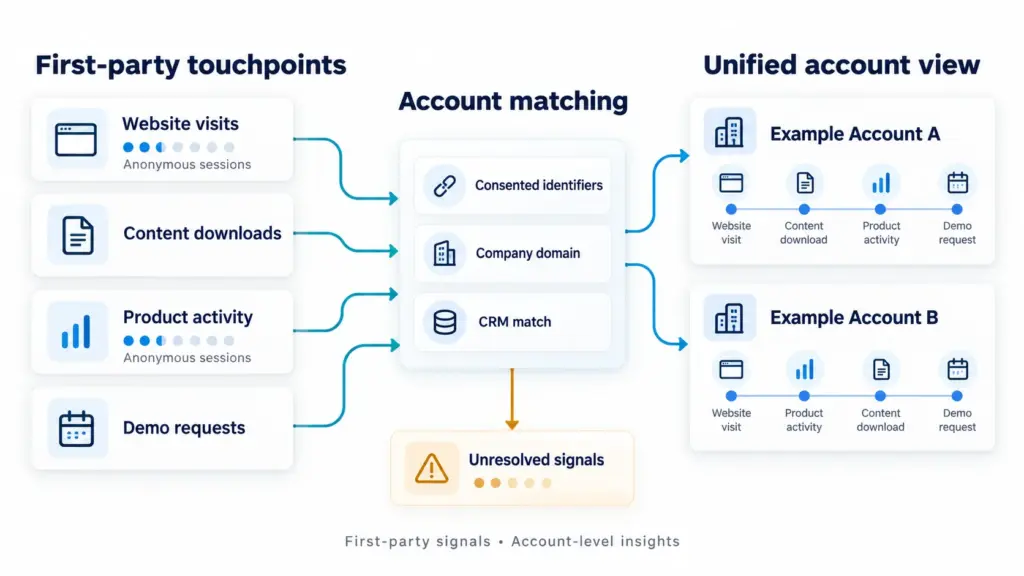
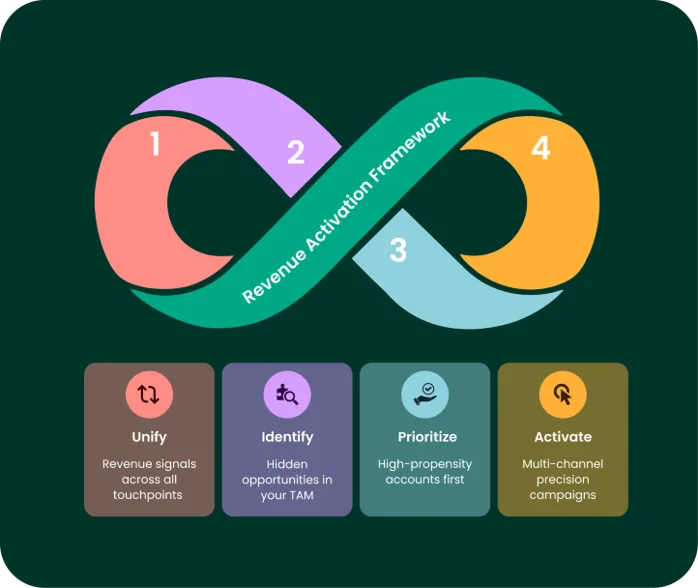
A revenue activation framework is a systematic approach to converting market interest into pipeline and pipeline into closed deals. It’s not just about attracting attention-it’s about orchestrating every touchpoint from awareness through advocacy to maximize revenue impact.
Think of traditional lead generation as one-directional: push content, capture emails, pass to sales. A revenue activation framework is bidirectional and continuous: it captures intent, qualifies at every stage, personalizes engagement, and measures impact on actual revenue outcomes.
The framework typically operates across four dimensions:
Here’s the hard truth: your competitor probably generates more leads than you. They’ve got bigger budgets. More channels. Louder noise.
But if you activate leads better, you’ll win more revenue. That’s the asymmetry revenue activation frameworks exploit.
Consider two scenarios:
Scenario A: Your team generates 500 leads per month via broad-targeting content and paid campaigns. About 20% convert to SQLs. Sales contacts them aggressively. Close rate is 5%. Monthly closed won deals: 5.
Scenario B: Your team generates 150 leads per month via targeted demand generation focused on ideal customer profiles. 60% convert to SQLs-because you’re only capturing people who actually fit. Sales uses a personalized revenue marketing strategy tailored to each segment. Close rate is 20%. Monthly closed won deals: 18.
Same sales team effort. Same time investment. One generates 3.6x more revenue by focusing on activation instead of volume.
That’s the framework in action.
Demand generation gets confused with lead generation constantly. They’re related but distinct.
Lead generation is the tactic: run ads, create landing pages, capture emails. Demand generation is the strategy: create conditions where your ideal customers believe they have a problem worth solving and your solution is worth considering.
A revenue activation framework starts with demand generation. You can’t activate demand you haven’t created. This means:
Once you’ve done this work, lead generation becomes easier because buyers self-identify. They raise their hands. You’re not chasing; they’re seeking.
A revenue activation framework doesn’t work without infrastructure. Revenue Operations (RevOps) teams build and maintain that infrastructure.
RevOps owns the CRM, the marketing automation platform, the data pipeline, and the playbooks that make everything repeatable. They’re the translation layer between marketing’s language (“MQLs”) and sales’ language (“SQLs”). They ensure that when marketing says a lead is qualified, sales believes it-because the definition is documented and the data is clean.
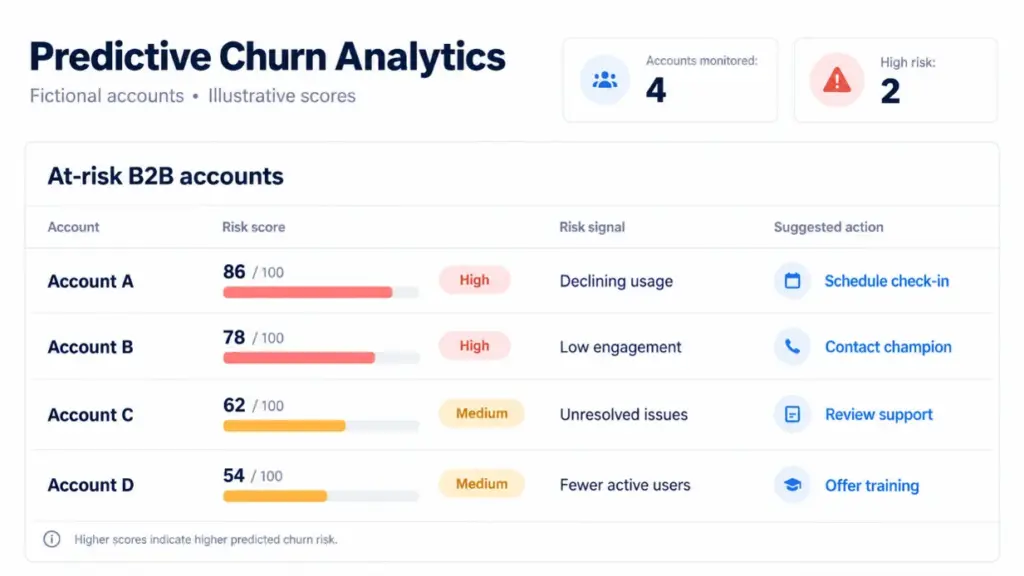
RevOps teams also manage the metrics that matter: pipeline generation velocity, win rates by source, time-to-close, customer acquisition cost against lifetime value. Without this visibility, teams fly blind.
Traditional marketing metrics are vanity. Clicks, impressions, cost-per-lead-these don’t predict revenue.
A revenue activation framework is measured by:
These metrics tell you whether your framework is actually activating revenue or just moving people through a funnel.
If your organization is still running lead generation as a standalone function-separate from sales, success, and operations-you’re leaving revenue on the table.
A revenue activation framework isn’t complex. It’s just systematic. It’s clarity about who you’re targeting, intentionality about how you engage them, alignment across teams about what “good” looks like, and discipline about measuring outcomes that matter.
Your competitors generating thousands of leads? Let them. You’ll be busy activating the ones that turn into revenue.
To learn more about revenue activation Visit Us Now.
A revenue activation framework is a systematic approach to converting market interest into revenue. It orchestrates demand generation, lead generation, qualification, engagement, and sales processes to maximize revenue impact. Unlike traditional lead generation, which focuses on volume, a revenue activation framework emphasizes velocity and outcomes. It aligns marketing, sales, and operations around shared metrics and playbooks designed to move buyers from awareness to closed deals efficiently.
Lead generation is a tactic focused on capturing contact information and volume. Revenue activation is a strategy that treats the entire buyer journey as a revenue system. Lead generation asks, “How many leads can we capture?” Revenue activation asks, “How can we move these leads to closed deals fastest?” This distinction shapes everything from targeting (narrower, more intentional) to engagement (stage-specific, personalized) to metrics (revenue outcomes, not lead counts).
Revenue Operations (RevOps) aligns marketing, sales, and success teams around shared revenue outcomes. RevOps owns the systems, data, and processes that enable collaboration-CRM configuration, marketing automation, lead scoring, playbook documentation, and performance reporting. RevOps teams ensure that marketing qualified leads meet sales standards, that sales qualified leads are truly qualified, and that insights flow back to marketing to refine B2B lead generation strategy. Without RevOps, a revenue activation framework is just theory.
Improve B2B lead generation by shifting from volume to activation. Start with clarity on your ideal customer profile and the problems they actively want to solve. Build demand generation before running campaigns-establish thought leadership and market positioning so leads self-identify. Implement rigorous qualification criteria so that marketing qualified leads actually meet sales standards. Integrate marketing and sales feedback loops; if sales rejects leads, understand why and adjust targeting. Track marketing ROI against closed deals, not lead counts.
Demand generation creates the conditions where buyers recognize they have a problem and your solution is relevant. Without demand generation, lead generation becomes purely transactional-you’re trying to convince people they need something they don’t believe they need. With demand generation, buyers seek you out. This dramatically improves pipeline velocity, conversion rates, and deal size. Demand generation also builds competitive advantage; it shifts market perception in your favor before leads even enter your funnel.