AI-driven intent data is reshaping ABM-helping B2B teams target smarter, convert faster, and scale without losing focus. Here’s how.
Nobody gets into B2B marketing because they love wasting budget on accounts that were never going to buy.
And yet – here we are. Quarter after quarter, teams pour time, money, and creative energy into outreach that lands in a vacuum. The sequence gets opened. Maybe clicked. Definitely not replied to. The account goes cold. The cycle repeats.
It’s exhausting. And honestly? It’s avoidable.
The reason most B2B lead generation efforts underperform isn’t effort. It’s not even strategy, really. It’s timing. It’s targeting. It’s reaching the wrong accounts – or the right accounts at the wrong moment – and wondering why nothing’s converting.
Account based marketing ABM was supposed to fix that. And it can. But only if you’re feeding it the right intelligence. That’s where AI-driven B2B intent data comes in – and why teams that are using it are running laps around those that aren’t.
Let’s get into it.
When account based marketing ABM first started getting serious traction, the pitch was irresistible. Stop chasing volume. Focus on the accounts that actually matter. Build real relationships with real decision-makers. Treat every target like a market of one.
Marketers loved it. Sales loved it. Leadership loved it. Everyone nodded enthusiastically in the kickoff meeting.
And then they tried to actually execute it – and hit a wall.
Because here’s what nobody tells you upfront: ABM is only as good as your ability to prioritize. And prioritization without real-time signal data is basically educated guessing. You build your ideal customer profile. You pull together a target account list. You look at firmographic fit – industry, revenue, headcount, tech stack. And then you stare at a list of 300 accounts wondering which ones you should actually be going after right now.
So you go alphabetical. Or you go by company size. Or your sales rep picks their favorites based on gut feel and LinkedIn stalking. And the accounts that are genuinely, actively, right-now researching a solution like yours? They never even make it to the top of the queue. Someone else gets there first.
That’s not a people problem. That’s a data problem. And B2B intent data is the fix.
Okay, so what actually is B2B intent data? Because it gets thrown around a lot, and the explanations are usually either too vague or too technical to be useful.
Here’s the plain version.
Every day, people at companies all over the world are Googling problems. Reading comparison articles. Watching product demo videos. Spending time on competitor pricing pages. Downloading research reports on topics they’re actively trying to solve. Each one of those actions is a signal – a breadcrumb that says “someone here is thinking about buying something.”
B2B intent data aggregates those signals and surfaces them so you can see which accounts are in active research mode right now. Not last quarter. Not based on what they told you in a survey. Right now, based on what they’re actually doing online.
That alone is powerful. But it’s still noisy on its own. You’d need a team of analysts working around the clock to make sense of the raw signal volume across a decent-sized target account list.
That’s where AI for B2B marketing comes in – and where things get genuinely exciting.
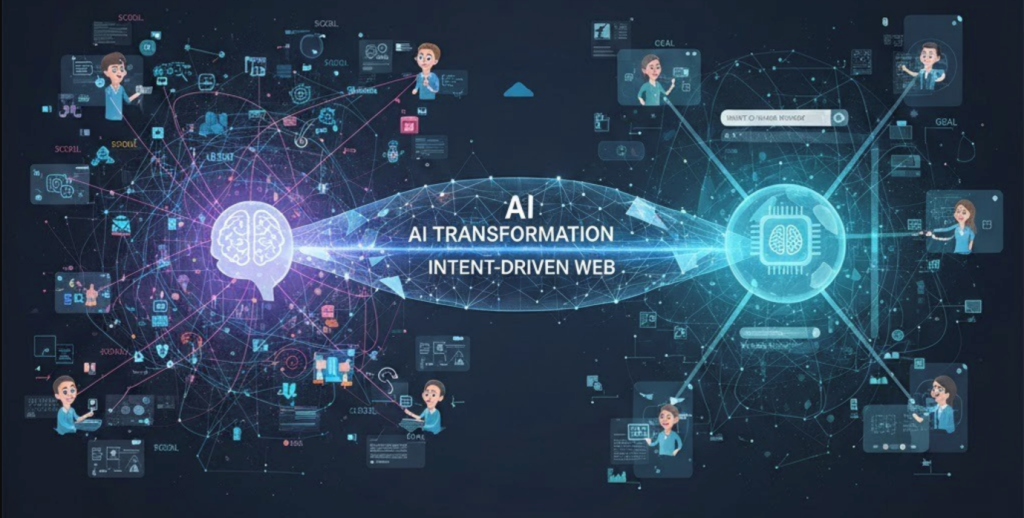
AI doesn’t just show you the signals. It interprets them. It weighs them against historical conversion patterns, account fit scores, and real-time behavioral context to tell you how strong the intent is, where the account is in their buying journey, and what kind of message is most likely to land right now. It turns a fire hose of behavioral data into a clear, actionable prioritization that your team can actually use.
That combination – sharp account based marketing strategy plus AI-processed intent intelligence – is what a modern go-to-market engine is built on.
Every sales rep has accounts they swear are “almost ready.” Sometimes they’re right. A lot of the time, they’re holding onto hope because they’ve already invested time and don’t want to admit the account has gone cold.
AI for B2B marketing takes the guesswork out of it completely. Instead of a static target list that gets reviewed once a quarter, you get a live, continuously updated ranking of which accounts are showing real buying signals today. An account that was quiet for months might suddenly surge in activity because their contract with a competitor is coming up for renewal, or because a new regulation just dropped that makes your solution urgently relevant.
AI catches that shift the moment it starts happening. Your team can be in their inbox before they’ve even decided to start formally evaluating vendors. That’s timing. And timing wins deals.
Most personalization in B2B is surface-level. “Hi [First Name], I saw you work at [Company] in the [Industry] space” isn’t personalization – it’s mail merge. Everyone’s seen through it for years.
Intent based marketing is different. It’s not about knowing who someone is. It’s about knowing what they’re actively trying to solve right now and meeting them there. There’s a world of difference between “here’s a relevant case study” and “here’s the exact business case your CFO is going to ask for when you take this internally.”
The second one closes deals. And AI for B2B marketing makes it possible to deliver that level of relevance at scale – automatically matching content, outreach sequences, and sales motions to where each account actually is in their decision process.
Be honest. How much does your team actually trust your lead scores?
If the answer is “sort of” or “we mostly ignore them,” you’re not alone. Most lead scoring models are built on rules that made sense at some point and never got updated. Open an email – five points. Visit the pricing page – ten points. Download a whitepaper – fifteen points. It’s a scoring system, but it’s not really predicting anything. It’s just tracking engagement and calling it qualification.
Predictive lead scoring is a completely different animal. It uses machine learning to process hundreds of signals simultaneously – including B2B intent data, behavioral patterns, account fit, and historical win/loss data – and produces a score that actually reflects likelihood to buy. Right now. For this account. Given everything the model knows.
For B2B lead generation teams, that’s transformative. It means your reps stop working low-quality leads because they technically hit a score threshold, and start concentrating effort where there’s genuine pipeline potential. Less noise. More revenue.
Okay, let’s address the elephant in every single B2B room.
Sales thinks marketing sends them garbage leads. Marketing thinks sales doesn’t follow up properly. Both sides have PowerPoint slides to prove their point. Leadership is tired of mediating. The whole thing is deeply unproductive and costs you more in missed revenue than anyone wants to calculate.
Account based selling works – really works – when both teams are operating from the same intelligence. When marketing is building campaigns around accounts that are showing active intent, and sales is prioritizing outreach to those same accounts at the same time, the friction disappears. Not because everyone suddenly got nicer. Because they’re finally looking at the same data and pulling in the same direction.
AI-driven B2B intent data is the shared foundation that makes that alignment actually stick. It’s not a process fix – it’s an intelligence fix. And it’s the thing that finally makes the sales-marketing relationship less painful for everyone involved.
Look, the vision is great. But “use AI and intent data for ABM” isn’t a strategy – it’s a direction. Here’s what teams that are actually executing this well are doing differently.
Here’s something worth sitting with.
The teams using AI-powered account based marketing ABM right now aren’t just getting a marginal improvement in efficiency. They’re building a compounding advantage. Every campaign teaches the model something. Every deal won or lost sharpens the scoring. Every cycle, the targeting gets tighter, the messaging gets more relevant, and the pipeline gets more predictable.
Meanwhile, teams still running static account lists and gut-feel prioritization are working twice as hard for half the result – and the gap isn’t staying the same. It’s growing.
AI for B2B marketing crossed the line from “interesting experiment” to “table stakes” faster than most people expected. For any team serious about account based selling at scale, the question isn’t whether to adopt it. It’s how much runway you’re willing to give your competitors while you’re thinking about it.
The spray-and-pray era of B2B lead generation is over. The teams winning now are the ones who know exactly which accounts to go after, exactly when to reach them, and exactly what to say when they do.
Account based marketing ABM powered by AI-driven B2B intent data and predictive lead scoring is how they’re getting there. It’s not a silver bullet – no tool is. But it’s the closest thing to a genuine competitive edge that B2B go-to-market has seen in a long time.
Get the intelligence right. Build the motion around it. Align the teams on the same signal. And then move – because the accounts that are in-market right now aren’t waiting for you to figure out your process.
Traditional account based marketing ABM leans on manual research, static lists, and gut-feel prioritization. AI-powered ABM brings in real-time B2B intent data and predictive lead scoring that continuously surface which accounts are actually in-market right now – making your whole go-to-market motion faster, sharper, and a lot less dependent on guesswork.
B2B intent data shows you which accounts are actively researching solutions like yours – before they’ve raised their hand or filled out a form. Building your account based marketing strategy around those signals means your team is showing up at exactly the right moment, which is why intent-driven ABM programs consistently outperform static-list approaches on pipeline and conversion metrics.
Traditional scoring models track past behavior using manually set rules that rarely get updated. Predictive lead scoring uses machine learning to weigh real-time signals, historical win/loss patterns, and account fit data simultaneously – producing a forward-looking score that actually reflects buying likelihood right now. For B2B lead generation teams, that means spending time on the right accounts instead of the loudest ones.
Intent based marketing gives both teams a shared, objective signal to anchor around – real buying behavior from real accounts, in real time. When marketing is running campaigns and sales is prioritizing outreach based on the same intelligence, account based selling becomes genuinely coordinated instead of just theoretically aligned.
Look for platforms that combine first- and third-party B2B intent data, offer real predictive lead scoring – not just rule-based qualification dressed up with an AI label – and integrate cleanly with your CRM and automation stack. The best AI for B2B marketing tools don’t just surface signals. They tell you what to do with them, and they get smarter every time you use them.