Discover why first-party execution beats the black box of third-party lead gen for sustainable B2B growth. Learn how to own your data and improve lead quality.
There’s a deal every B2B marketing team has made at some point: pay a vendor, get a list, and hope for the best. Third-party lead generation promises scale and speed. You don’t have to build anything. You just buy access to leads that someone else sourced, scored, and packaged.
The problem? You have no idea what happened inside that black box.
Who filled out the form? Was it a genuine opt-in or a checkbox buried in fine print? Is the buyer actually in-market, or did their email just land in a database because they downloaded a generic whitepaper two years ago? You can’t answer any of those questions, because you don’t own the data, the relationship, or the context.
That’s the core tension in first-party vs third-party lead generation. One hands you a shortcut. The other hands you control. And in 2026, the gap in outcomes between the two is getting harder to ignore.
Third-party lead gen operates on aggregation. Vendors pull contact information from across the web, run it through intent models, append firmographic data, and sell it to whoever’s buying. On paper, it looks efficient. You get a spreadsheet of names that match your ICP, and your SDRs get to work.
But the signals are borrowed. The intent scores are built on someone else’s methodology, someone else’s data sources, and someone else’s definitions of what “in-market” means. You’re not seeing what a prospect actually did on your website, in response to your content, or after interacting with your brand. You’re seeing a proxy, filtered through another company’s logic.
And that has downstream consequences. When lead nurturing sequences are built on weak foundations, conversion rates suffer. When Marketing Qualified Leads (MQLs) arrive from third-party sources and consistently fail to convert downstream, pipeline projections become unreliable. Sales starts to lose trust in marketing. Everyone’s busy, but the number doesn’t move.
There’s also the regulatory dimension. Externally sourced contact data without clear consent chains is increasingly a liability in markets subject to GDPR, CCPA, and similar frameworks. That risk doesn’t disappear just because you bought the list from someone else.
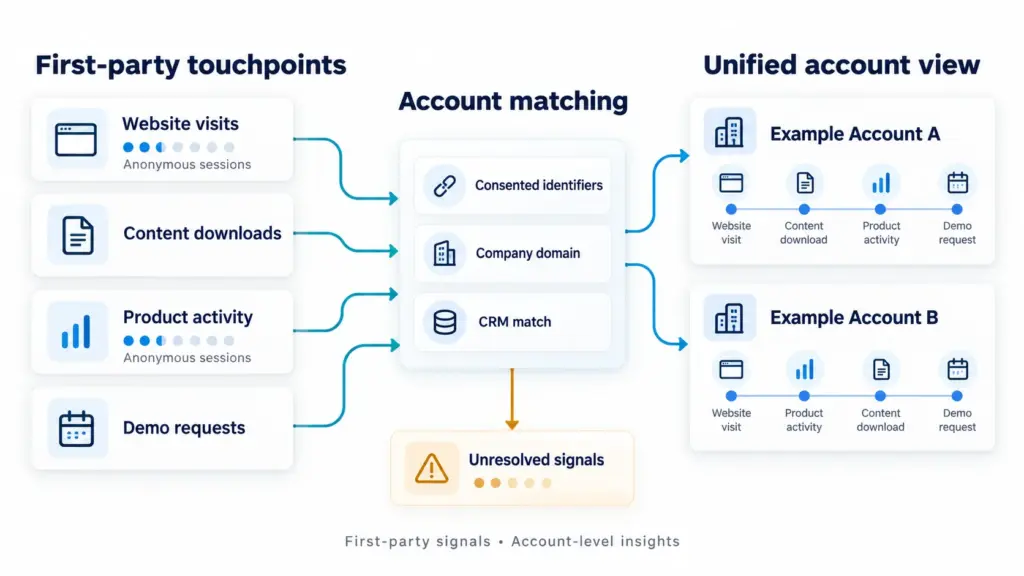
First-party data is what your company collects directly from your audience through owned channels: your website, your content, your events, your email programmes, your product interactions. It comes with context baked in.
When a prospect visits your pricing page three times in a week, downloads your technical documentation, and opens your nurture email on a Tuesday morning, that’s a signal. It’s your signal. It lives in your CRM data, tied to an actual person who has engaged with your brand. You know what they looked at, when they looked at it, and how far down the funnel they’ve moved. That’s the foundation of a lead generation strategy that compounds over time.
Here’s what owned channel execution gives you that third-party vendors can’t:
The pushback against first-party lead generation strategy is usually about volume. First-party channels take longer to build. You can’t just buy ten thousand contacts and call it a pipeline.
That’s a fair point, but it’s also a short-term frame. The question isn’t whether you can match third-party volume immediately. The question is whether the leads you’re generating are actually moving through your funnel and becoming customers.
A hybrid approach is often the right starting point. External vendor data can still serve a role in identifying companies within your ICP, particularly for net-new account discovery at the top of the funnel. The mistake is relying on it for lead nurturing and conversion, where owned context matters most.
The better model uses third-party signals to inform outreach and first-party engagement to qualify and advance. You identify the account through external data, then you create the conditions for them to raise their hand directly. When they do, that interaction becomes first-party, and the quality of the relationship from that point forward is entirely different.
Leads that arrive from first-party channels also tend to have richer data attached. You know which content influenced them, which campaigns touched them, and which product areas they’ve been exploring. That context makes the handoff to sales meaningfully more productive.
Building owned data capability isn’t just a marketing decision. It’s an infrastructure decision. Your website needs to be instrumented properly. Your content needs to be gated or tracked in ways that capture identity without creating friction that drives people away. Your CRM needs to be connected to your marketing automation, your content platform, and your sales tools so that every touchpoint contributes to a unified buyer profile.
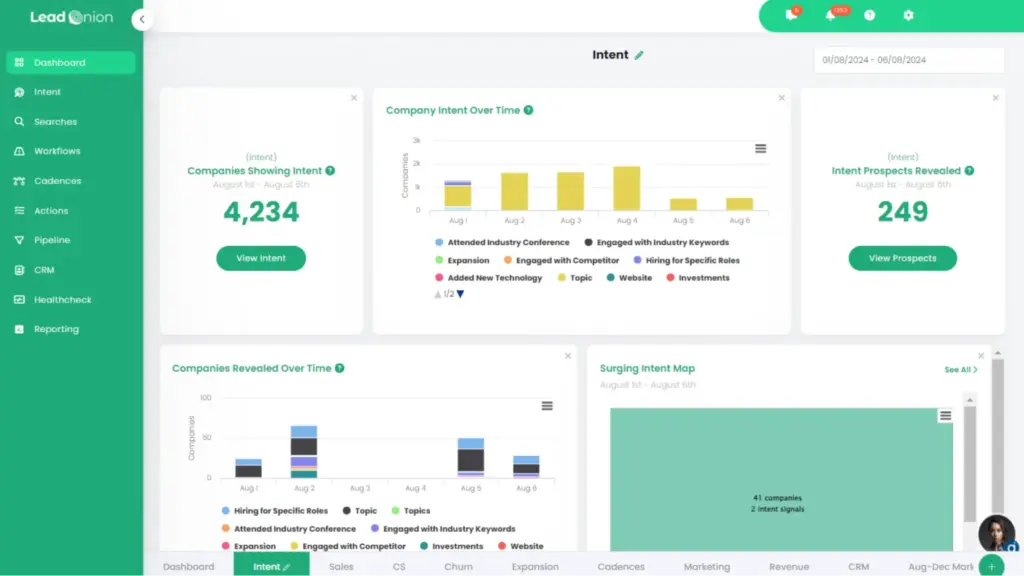
Buyer signal providers can also be integrated into this stack in a way that enhances owned signals rather than replacing them. When you know that a target account has been researching topics relevant to your category across the web, and you can see that they’ve also been engaging with your content, the combination gives you a much clearer picture of timing and readiness.
The investment is real. But so is the payoff. Businesses that build strong first-party capability aren’t just improving their B2B lead generation metrics. They’re building a proprietary asset that compounds in value the longer they operate it.
First-party lead generation refers to attracting and capturing prospects through channels and touchpoints that your business owns directly, such as your website, content, email campaigns, and events. The data collected comes from prospects who voluntarily engaged with your brand, making it more accurate, consent-compliant, and contextually rich than leads sourced through external vendors.
First-party data is collected directly by your company from your own audience through owned channels. Third-party data is gathered by external organisations from a wide range of sources and sold to businesses looking to expand their reach. The former tends to be higher quality, more accurate, and easier to use compliantly, while the latter offers scale but less transparency about sourcing and intent.
Owning your data gives B2B marketers direct visibility into how prospects engage with their brand, which content influences decisions, and where buyers are in their purchasing journey. This context makes lead nurturing more precise, improves MQL quality, and enables more productive sales conversations. It also keeps businesses on the right side of data privacy regulations.
High-quality B2B leads come from a combination of strong content that attracts the right buyers, well-instrumented owned channels that capture meaningful engagement signals, and a CRM infrastructure that connects every touchpoint to a unified buyer profile. Integrating intent data into this stack helps identify which accounts are actively researching your category, allowing your team to prioritise outreach and personalise engagement.
The key benefits include greater accuracy, full consent compliance, richer context around buyer behaviour, stronger CRM data that reflects real pipeline progression, and the ability to build proprietary insights over time. Businesses that invest in owned data capability reduce their dependence on external vendors, improve lead quality, and develop a compounding advantage in how they identify, engage, and convert their ideal customers.