Discover how enterprises can prepare cloud security for Q-Day with PQC migration, quantum-safe encryption, and a practical quantum-readiness strategy.
The encryption protecting your cloud data right now has a shelf life. Somewhere in the coming years, a large-scale quantum computer is expected to break the public-key math that secures most enterprise systems. Security teams call that moment Q-Day. It sounds like a distant problem, but the smart move is to start preparing while there is still time to do it calmly, on your own schedule, instead of during a crisis.
This guide explains what changes, what stays safe, and how to build a plan you can actually execute.
Post-quantum cryptography is a family of encryption methods designed to stay secure even against quantum computers. Today’s public-key systems, like RSA and ECC, depend on math problems that ordinary computers cannot solve in any reasonable time. A capable quantum machine running Shor’s algorithm could solve those same problems in hours.
Quantum-safe encryption replaces those exposed methods with algorithms built on problems that quantum computers cannot shortcut. In 2024, NIST finalized its first set of standards, giving enterprises approved, vetted algorithms to build around. That matters because it turns a research topic into something your security and engineering teams can plan against.
Not every algorithm faces the same risk, and this is where many teams get the threat wrong. Symmetric encryption, such as AES-256, holds up far better than public-key encryption. Quantum computers do weaken symmetric keys through Grover’s algorithm, but the effect is limited. A 256-bit key still offers strong protection even after that theoretical speedup.
Public-key encryption is the real soft spot. This is why quantum-resistant encryption work focuses on replacing key exchange and digital signatures rather than the bulk data protection that symmetric ciphers already handle well. For most enterprises, the practical takeaway is simple: the urgent job is upgrading how keys are shared and how identities are verified, not rebuilding every layer of your stack.
The threat is not only in the future. A tactic known as harvest now decrypt later means attackers can steal encrypted data today and store it until quantum hardware is ready to open it. In other words, data you consider safe right now could already be sitting in someone else’s archive, waiting.
Long-lived information is most exposed: financial records, health data, signed contracts, trade secrets, and anything under a multi-year compliance obligation. If a dataset needs to stay confidential for a decade, its protection has to survive the arrival of quantum computing. Any cloud encryption guarding that kind of data needs a migration plan well before Q-Day actually lands.
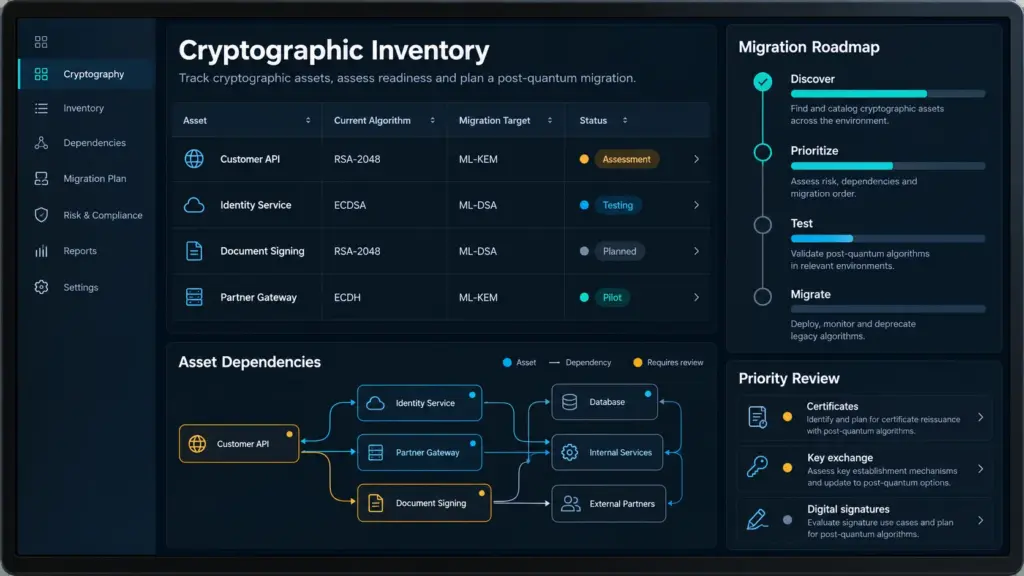
Knowing how to prepare for post-quantum cryptography starts with visibility, not panic. You cannot protect what you have not mapped. A workable post-quantum cryptography migration strategy usually moves through a few clear stages:
None of these steps require a finished quantum computer to exist. They are useful work you can start this quarter.
The single most valuable goal in this whole effort is cryptographic agility: the ability to change encryption algorithms without rebuilding your systems. Standards will keep evolving, and the first algorithms you deploy are unlikely to be the last ones you run.
Systems designed this way turn each future update into a configuration change instead of a months-long rebuild. That is the difference between a controlled, repeatable process and a scramble every time guidance shifts. If you invest in one capability now, make it this one. It pays off long after the current standards are updated.
Q-Day is an unusual kind of risk. The direction is known, the timeline is roughly understood, and the fixes are already being standardized. That combination means the enterprises that act early will have a real advantage over those that wait for a headline to force their hand.
Start by finding where your cryptography lives. Protect your long-lived data first. Design every new system so algorithms can be swapped with minimal effort. Do that, and your cloud stays secure on the day the math finally changes, without the last-minute panic that catches everyone else.
It is a set of encryption methods built to stay secure against both today’s computers and future quantum machines. It replaces vulnerable public-key algorithms with ones based on math problems that quantum computers cannot solve quickly.
Because quantum computers are expected to break the public-key encryption that protects most systems. Enterprises with sensitive, long-lived data need protection that will still hold years from now, especially given harvest-now-decrypt-later attacks already collecting encrypted data today.
They inventory where encryption is used, rank systems by risk and data lifespan, pilot NIST-approved algorithms in low-risk settings, and coordinate with cloud providers. Designing for algorithm flexibility keeps each future update manageable.
It is encryption designed to resist attacks from quantum computers. It focuses mainly on securing key exchange and digital signatures, since those public-key functions are the parts most exposed to quantum attacks.
It threatens the public-key encryption that secures data in transit and identity verification across cloud services. Symmetric protection like AES-256 stays comparatively strong, so the priority is upgrading key exchange and signatures before capable quantum hardware arrives.