Learn how predictive churn analytics and machine learning help B2B teams spot at-risk accounts early and build a stronger customer retention strategy.
Most B2B teams find out an account is leaving when the cancellation email lands. By then, the decision was made weeks ago. The quiet signs were there: fewer logins, stalled champions, support tickets that went unanswered.
That’s the gap predictive churn analytics closes. Instead of reacting to lost revenue, you spot the risk early and act while the relationship is still recoverable.
Predictive churn analytics uses historical and live account data to estimate which customers are likely to cancel or downsize, and roughly when. It’s a focused branch of predictive analytics, built around one question: who’s drifting away, and why?
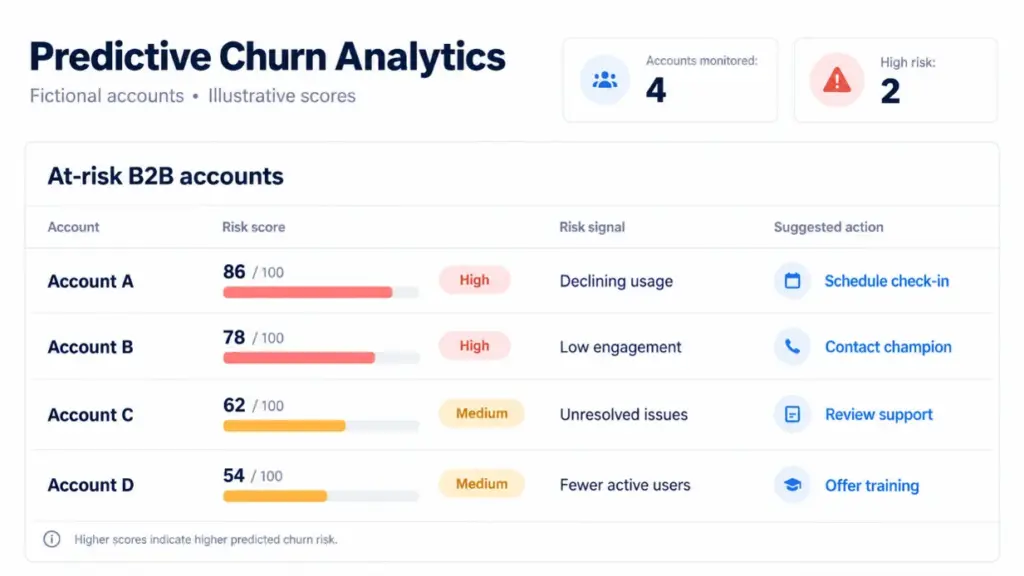
The output isn’t a vague hunch. It’s a ranked list of at-risk customers, each with a probability score and the behaviors driving it. Your customer success team gets a place to start on Monday morning instead of a dashboard full of noise.
Consumer churn is fast and high volume. B2B churn is slow, quiet, and expensive. You might have 300 accounts instead of 300,000, and each one carries real weight in annual recurring revenue.
Decisions also involve committees. A power user may love your product while a new CFO questions the renewal. That’s why B2B churn prediction has to look beyond product usage. It needs contract data, stakeholder changes, support sentiment, and billing patterns in the same picture.
A solid customer churn prediction model for SaaS doesn’t need exotic inputs. It needs clean ones. Most teams get strong results from a handful of sources:
The trick is consistency. If your CRM, billing platform, and product logs don’t agree on who a customer is, the model will learn from a distorted view. Fix identity matching first.
You don’t need a data science lab to start. Logistic regression gives you a transparent baseline. Gradient boosting and random forests usually improve accuracy by catching non-linear patterns, like a usage dip that only matters when it coincides with a support escalation.
Whatever the method, the process looks familiar. You label past accounts as retained or churned, train on their behavior in the months before that outcome, and test the model on accounts it hasn’t seen. Then you check whether the scores hold up in the real world, not just on paper.
One caution: accuracy alone can mislead. If only 8% of accounts churn, a model that predicts “nobody leaves” is 92% accurate and completely useless. Focus on precision, recall, and how early the warning arrives. A correct alert three weeks before renewal is worth far less than one three months out.
A score sitting in a spreadsheet saves nobody. The value comes when it changes what your team does. Good churn prediction feeds a clear playbook:
This is where predictive customer analytics for B2B earns its budget. It tells you where a limited team should spend limited hours. Pair it with a sharper customer retention strategy and you stop treating every renewal the same.
You can build in-house or buy. Purpose-built churn analytics software gets you moving faster, usually with connectors to your CRM and support tools. Customer health score software is a lighter option when you want a transparent, rules-based view before investing in machine learning.
Whichever route you pick, ask four questions. Can it explain why an account is flagged? Does it refresh scores often enough to matter? Can your customer success managers act on it inside tools they already use? And can you measure whether it actually reduced churn?
Teams tend to stumble in the same few places. They train on too little history. They ignore seasonality in renewals. They build a model nobody trusts because it can’t explain itself. And they forget that predictions decay, so an unmonitored model slowly gets worse.
Treat the model like a product. Review it quarterly, retrain when behavior shifts, and keep a feedback loop from customer success back to the data team. The people talking to customers usually notice changes before the numbers do.
You don’t need a perfect system on day one. Pick one segment, build a simple model, and test it against the accounts you already worry about. If it flags the ones your team suspected and surfaces a few surprises, you’ve got something worth expanding.
Retention is quieter than acquisition, but it compounds. Every account you keep is revenue you don’t have to win again.
It applies statistical and machine learning methods to account data to forecast which customers may cancel. It gives teams an early, ranked view of at-risk customers so they can step in before renewal.
Teams combine usage, support, billing, and relationship data, label past accounts as retained or churned, and train a model on the patterns that came before each outcome. Good B2B churn prediction then scores live accounts and refreshes those scores regularly.
Start with product usage, support tickets, contract details, and payment history. Add stakeholder changes and survey feedback when you can. Clean, matched records matter more than volume.
Tier accounts by risk and value, then assign a specific action to each tier. High-value accounts at risk get executive outreach, while healthy accounts become expansion candidates. That’s the practical core of retention planning.
No. A simple rules-based customer health score software setup or even a spreadsheet model can work for a pilot. Dedicated tools become worthwhile once you need automation, scale, and CRM integration.