Discover how digital twins enable real-time asset monitoring, predictive maintenance, and smarter industrial asset management using live telemetry data.
Most plants don’t fail all at once. A bearing runs a little warm. A transformer drifts out of tolerance. A pump vibrates differently on Tuesday than it did on Monday. The signs are there, but nobody’s watching closely enough, or the data sits in five systems that never talk to each other. That’s the gap digital twins are closing, and it’s why industrial digital twins have moved from pilot projects to budget lines.
A digital twin is a virtual replica of a physical asset, process or system that stays in sync with the real thing through live data. In digital twin for asset management, that replica mirrors a turbine, a substation, a production line or a pipeline segment, and it updates as conditions change.
It isn’t a static 3D model, and it isn’t just a dashboard. It’s a working model that lets engineers ask “what happens if” without touching the actual equipment. Run the heat test in the model. Try the new load profile in the model. Keep the real machine running.
The concept is simple. The execution depends on data quality, and that’s where telemetry comes in.
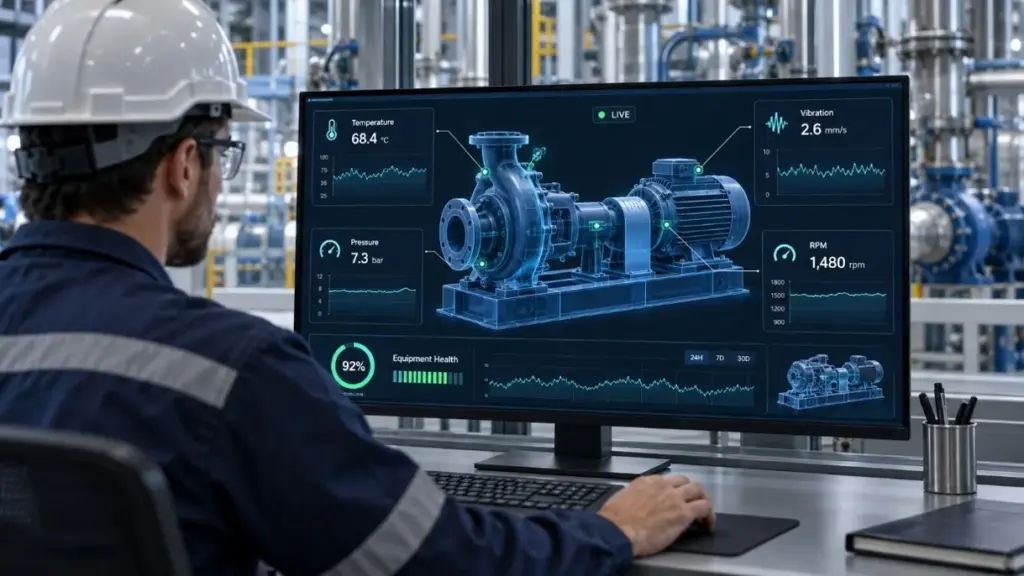
Telemetry is the stream of readings your equipment sends back: temperature, vibration, pressure, current, flow rate, location. Real-time telemetry for industrial assets is what separates a living twin from an expensive drawing. Without it, the model drifts away from reality within weeks. With it, the twin reflects what’s happening now, not what an inspector saw last quarter.
Here’s how the loop usually works:
Sense, sync, simulate, act. Every mature set of digital twins runs some version of that cycle.
Not every twin does the same job. The types of digital twins most teams encounter fall into four levels:
Most organizations start at the asset level and expand from there. Trying to model an entire facility on day one is a reliable way to stall a project.
A manufacturing digital twin of a production line lets teams test a change in speed, sequencing or maintenance windows before committing to it. It catches quality drift early and trims unplanned downtime. The wider use of digital twin in industry reaches into energy, mining, oil and gas, transport and water, and industrial digital twins in those sectors tend to pay back fastest on the most expensive equipment.
Utility asset management is an especially strong fit. Utilities run transformers, pipes, substations and meters spread across enormous areas, and plenty of that equipment is decades old. A twin fed by live readings helps crews decide which asset needs attention first instead of following a fixed calendar. Replacing equipment on age alone wastes money. Replacing it on condition doesn’t. That’s why utility asset management teams are some of the most active adopters.
When connected assets report their condition continuously, the twin can learn what “normal” looks like for each one. A compressor that’s been running fine for three years has its own baseline. A slight shift in vibration and temperature together, even inside the alarm limits, can signal trouble weeks before a breakdown.
That early warning changes how maintenance gets planned. Crews schedule work during planned stops, order parts ahead of time and avoid the emergency callout at 2 a.m. The twin also lets planners simulate the impact of delaying a repair, so the decision rests on evidence rather than gut feel. Across a fleet of connected assets, those small calls add up to real savings.
A sensible rollout for digital twins for industrial asset management looks like this:
Prove value on one asset, then scale. Teams that do it in that order keep executive support, because the results show up early.
The asset base in most industries is aging, skilled talent is thin and downtime is expensive. Digital twins won’t fix all of that, but they give your team a clearer view and more time to act. Start small, feed the model good data and let the results make the case.
It’s a live virtual copy of a physical asset, fed by sensor data, that shows its condition and behavior in real time. Teams use it to monitor health, test scenarios and plan maintenance without disrupting operations.
Plants and utilities use digital twins to track equipment health, forecast failures, simulate changes and prioritize maintenance and capital spend. They apply to single machines, full production lines and infrastructure like substations and pipelines.
It’s the continuous flow of readings such as temperature, vibration and pressure sent from equipment to a central platform with minimal delay. It’s the raw material a twin needs to stay accurate.
By comparing live data with each asset’s normal baseline, digital twins spot early signs of wear and estimates remaining life. That lets crews fix things on a planned schedule instead of reacting to breakdowns.
IoT sensors and gateways capture and transmit the data that keeps the twin current. Without that steady stream, the model would be a snapshot rather than a living view.