Learn how scalable data architecture can break down data silos, unify B2B data, improve analytics, and support faster, data-driven business decisions.
Most B2B organizations are sitting on more data than they know what to do with. Sales teams have their CRM exports. Finance runs its own dashboards. Marketing tracks attribution in a separate platform. And somewhere in IT, there’s a data lake no one outside of engineering can actually query.
The result? Leadership asks for a unified view of pipeline health or customer churn, and three departments produce three different numbers – all pulling from the same underlying business reality.
This is what data silos cost you in practice. Not just storage inefficiency or duplicate tooling. They cost you confidence in your own numbers. And in B2B, where long deal cycles, account complexity, and multi-stakeholder decisions demand clarity, fragmented data is a real strategic liability.
Here’s the thing – data silos don’t usually form because people wanted them to. They form because teams moved fast, adopted tools that solved immediate problems, and no one had time to think about how those systems would eventually need to talk to each other.
Over time, each department ends up with its own pipeline, its own schema, its own transformation logic. When you finally try to pull everything together for a board-level report or a strategic planning cycle, the seams show.
That’s an architecture problem. And it needs an architecture solution.
Scalable data architecture changes the equation by designing for growth and interoperability from the start – rather than trying to bolt those things on later. Instead of asking “how do we store this data?” the question becomes “how does this data connect to everything else we know?”
Let’s be specific about what actually goes wrong when data silos persist inside a growing B2B organization.
Data quality suffers first. When the same customer record lives in five systems with five slightly different schemas, small discrepancies compound. A typo in one field, a missing value in another, a timestamp that’s off by a timezone – none of these are catastrophic on their own. Together, they erode trust in your data over time.
Data integration fails at the seams. Moving data between systems becomes a patchwork of custom scripts, scheduled exports, and manual hand-offs. Every connection is a fragility point. When a source system changes its schema, downstream pipelines break. Teams spend more time maintaining connections than analyzing what’s in them.
Reporting becomes a game of source attribution. Which system is the source of truth for revenue? Why does the sales report show a different close rate than the finance model? When data silos produce inconsistent outputs, stakeholders stop trusting dashboards and go back to spreadsheets – which makes everything worse.
Understanding how to build a scalable enterprise data platform starts with accepting that there’s no single tool that solves everything. The real work is in the design principles.
Data consolidation is the first principle. Bringing data from disparate sources into a unified layer – whether that’s a modern data warehouse, a lakehouse, or a federated query layer – creates a single place where definitions are consistent, access is governed, and lineage is traceable.
Data governance is the second. Without it, consolidation just moves the mess to a bigger bucket. Governance means defining who owns each data domain, how data is classified, how long it’s retained, and who has access to what. It sounds bureaucratic, but in practice it’s what makes self-serve analytics actually work safely.
Data integration is the third. Modern ELT pipelines – using tools like Fivetran, Airbyte, or dbt – can ingest from dozens of sources, normalize schemas, and maintain data lineage without brittle custom scripts. The investment in proper data integration infrastructure pays off quickly in reduced maintenance overhead and faster time to insight.
Data quality monitoring closes the loop. You can’t improve what you don’t measure. Quality checks baked into the pipeline – not bolted on after – catch issues before they reach dashboards and erode stakeholder trust.
These terms get used interchangeably, but they’re not the same thing, and the differences matter when you’re choosing an architecture.
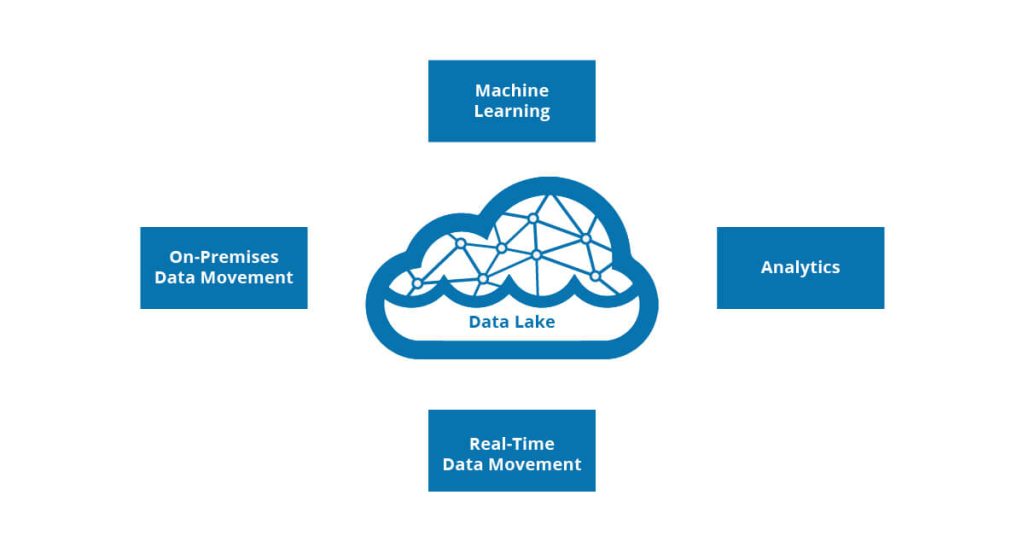
A data lake stores raw, unstructured or semi-structured data at scale. It’s flexible and cheap for storage, but without governance and transformation layers on top of it, it quickly becomes a data swamp. Raw data with no access controls, no defined schemas, and no documentation doesn’t help analysts – it slows them down.
A data warehouse enforces structure. Data is transformed before it lands, schemas are well-defined, and queries are fast. The tradeoff is flexibility – structured warehouses are less suited to the unstructured data types that increasingly matter in B2B contexts (support transcripts, email signals, product usage logs).
A data lakehouse blends both approaches. You get the storage economics and flexibility of a lake with the governance and query performance of a warehouse. Platforms like Databricks and Snowflake have moved heavily in this direction, and for most enterprise B2B teams, the lakehouse architecture is now the pragmatic default.
Figuring out how to eliminate data silos in an organization is as much a political challenge as a technical one. Teams have built workflows around their existing systems. Migrating to a unified architecture means re-earning trust from stakeholders who’ve been burned by previous integration projects.
The strongest case isn’t theoretical. It’s a concrete example: pick the report your leadership asks for most often that produces inconsistent results. Trace each number back to its source. Map the transformation logic, the ownership gaps, and the manual steps that introduce variance. Show exactly where data consolidation would collapse five conflicting figures into one reliable one.
That’s the pitch. Not “better architecture” in the abstract – but one specific decision made faster, with more confidence, because the data actually agreed. Leadership responds to that clarity far more readily than a migration roadmap.
Scalable data architecture isn’t a one-time project. It’s an ongoing commitment to treating data as infrastructure – something that needs the same care, investment, and governance as the systems your customers interact with directly. The organizations that get this right don’t just have cleaner dashboards. They make better decisions, faster. In B2B, that’s a durable competitive advantage.
Data silos typically form when teams adopt tools independently, without a shared data strategy. As each department builds its own pipelines, schemas diverge, definitions conflict, and data becomes harder to unify over time. Rapid growth and acquisitions accelerate this pattern.
When the same metric is calculated from different source systems with different transformation logic, reports naturally disagree. Without a unified data consolidation layer and consistent definitions, every team’s dashboard tells a slightly different story – making it hard to trust any of them.
Not on its own. A data lake solves the storage problem but not the governance or accessibility problem. Without data governance layers, access controls, and well-defined schemas, a data lake can quickly become a data swamp – technically centralized but practically unusable for most teams.
A data lake stores raw, flexible data at scale – great for volume but harder to query directly. A data warehouse enforces structure and delivers fast, reliable queries but is less flexible with unstructured inputs. Data integration practices and the data lakehouse architecture now blend both approaches for most enterprise use cases.
When you’re dealing with mixed data types – structured transactional data alongside unstructured sources like logs, transcripts, or product telemetry – and you need both flexibility and query performance. A lakehouse is also the right move when data quality and governance are priorities, since it supports transformation and access controls more cleanly than a raw lake.