Learn how zero-trust data security protects data at rest, in transit, and in use with encryption, IAM, least privilege, DLP, and continuous verification
Most breach post-mortems end in the same uncomfortable place: nothing was technically broken. A credential worked. A session was trusted. A scheduled job copied a customer table into a bucket never meant to hold it, and nobody noticed until it had travelled.
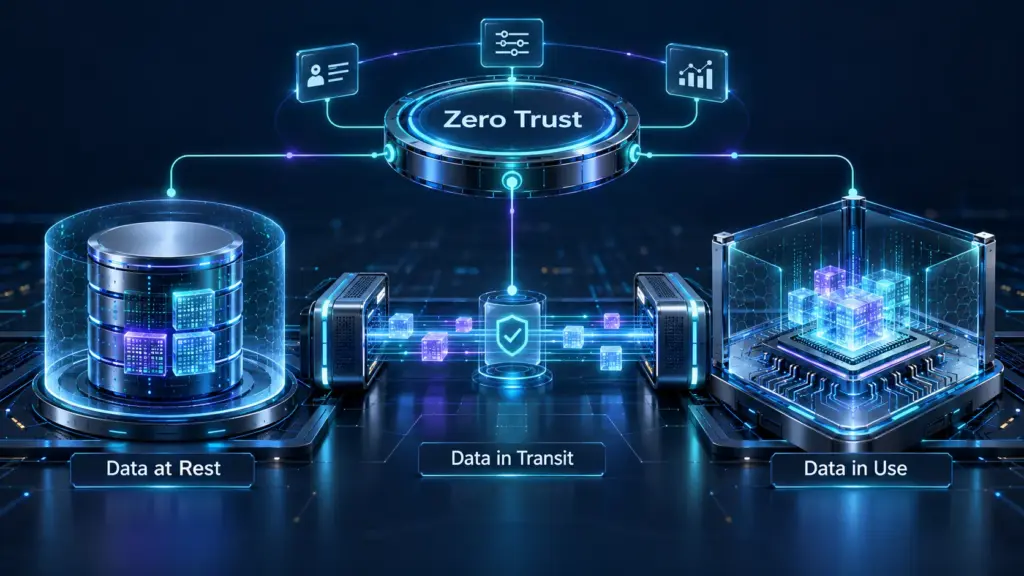
That is the problem zero-trust data security was built for. Rather than guarding a building and assuming whoever gets inside belongs there, it follows the information through every state it occupies: sitting in storage, moving between services, loaded into memory while an application works on it. The payoff is practical. Fewer places where one stolen credential becomes a full extraction event.
Perimeter thinking made sense when applications lived in one data centre and staff worked from one office. The firewall drew a line, and data security meant defending it.
That line dissolved. Workloads run across several clouds, contractors log in from personal laptops, SaaS tools hold production records, and AI pipelines pull from systems nobody mapped. Cloud data security failures trace back to this gap: controls that assume a trusted interior, applied to an environment without one.
Credential theft, session hijacking and over-permissioned service accounts walk past a perimeter without triggering it, and lateral movement is cheap once internal traffic goes uninspected.
A zero trust approach to data security replaces assumed trust with a repeated question: should this identity, on this device, reach this specific record, right now?
Continuous verification re-evaluates authorisation during a session instead of granting it once at login. A device falls out of compliance, a user pulls ten thousand rows at 3 a.m., a token appears from an unfamiliar region. Continuous verification reacts to those changes rather than waiting for the next sign-in.
Microsegmentation limits what a compromised identity can reach. Instead of flat networks where one foothold exposes dozens of systems, workloads sit in isolated zones with explicit rules between them.
Least privilege, applied to records and not only to systems, governs which fields and rows an identity may touch.
Stored data is the easiest state to protect and the easiest to protect badly. Disk-level encryption satisfies auditors and does little once an application with broad database permissions is compromised, since it decrypts on request.
Stronger practice layers it:
Classification is tedious. It also makes later controls enforceable, since a policy can only follow records it knows exist.
Transit protection goes further than TLS on public endpoints. Internal service-to-service traffic deserves the same treatment, which is where mutual TLS and a service mesh earn their place inside a zero trust architecture. Both sides prove identity, and unencrypted internal hops stop being acceptable.
Three habits matter:
Data loss prevention belongs here too, watching for regulated patterns leaving sanctioned paths: a customer export attached to personal webmail, a database dump pushed to an unapproved bucket.
Data in use has historically been the gap. Information decrypted into memory is readable by anything with enough privilege on that host, including a compromised hypervisor or a rogue administrator.
Confidential computing closed much of that opening. Hardware-based trusted execution environments isolate memory so the infrastructure operator cannot inspect it, which matters for multi-tenant workloads and third-party analytics.
This is no longer research-stage. Major providers offer confidential VMs and enclaves as standard instance types, putting zero-trust data protection in use within reach of ordinary engineering teams.
Identity and access management sits underneath all three states. Strong authentication, device posture checks, just-in-time elevation and short-lived credentials reduce the standing access attackers inherit.
Data loss prevention and monitoring close the loop. Policies block, quarantine or alert, while telemetry from identity, network and storage feeds baselines that catch a service account reading records it has never touched.
Among zero trust data protection best practices, sequencing matters more than tooling. Classify, restrict access to what classification reveals, encrypt by sensitivity, monitor, then automate response. Teams who buy platforms before classifying end up pointing expensive controls at an unmapped estate.
Full zero trust architecture rollouts fail when they run as one programme on a two-year timeline. The versions that work pick a single crown-jewel dataset, map who and what touches it, strip standing access, encrypt at field level, add continuous verification on that path, then measure what breaks. Each pass is small enough to finish and specific enough to prove, which is how data security budgets survive a second year.
Friction is the other obstacle. Controls that block legitimate work get disabled or routed around, so tune policies against real usage before enforcement and give people a sanctioned path for whatever you restrict.
It removes assumed trust from every request. Each attempt to reach a record is authenticated, authorised against least-privilege policy and logged, wherever it comes from. Zero-trust data controls stay attached to the information through encryption, tokenisation and policy enforcement, so protection does not depend on where it sits.
It is a structure built on four layers: classification, identity and access control, encryption across all three data states, and monitoring with automated response. Microsegmentation and least privilege contain the blast radius, while telemetry shows whether controls hold. Most organisations align to NIST SP 800-207 or the CISA maturity model, then adapt it to their data security obligations.
Through layered encryption, separated custody of encryption keys, tokenisation of sensitive identifiers and access policies evaluated per request. Classification comes first, because unmapped copies in backups and test environments are what leak.
Every connection is encrypted and mutually authenticated, including internal service-to-service traffic. Policy follows workload identity rather than network location, egress is inspected for unusual destinations, and continuous verification covers long-lived sessions that would otherwise go unchecked after login.
Confidential computing keeps data encrypted while it is processed, inside hardware-based trusted execution environments the host OS and hypervisor cannot read. Where workloads cannot run in an enclave, homomorphic encryption, secure multi-party computation and differential privacy cover narrower cases.