Learn how cryptographic agility helps B2B organizations prepare for post-quantum cryptography, migrate algorithms, and strengthen infrastructure against quantum threats.
Somewhere in your stack, an algorithm is quietly doing its job. It signs a certificate, wraps a session key, or protects a backup nobody has opened in years. For decades, nobody questioned it. Now the ground is shifting. Quantum computing is moving from research papers into real roadmaps, and the math behind most business traffic today has an expiry date. The teams that handle this well won’t be the ones who guessed the perfect replacement. They’ll be the ones who built cryptographic agility into their systems early enough to swap algorithms without breaking everything around them.
Most of today’s enterprise cryptography leans on problems that classical computers find painfully slow to solve, such as factoring large numbers. A sufficiently powerful quantum machine changes that equation. Algorithms like RSA and elliptic curve schemes, which sit underneath TLS, VPNs, and code signing, become breakable in principle.
Here’s the part that catches people off guard. The threat isn’t only about the day a capable quantum computer shows up. Attackers can capture encrypted data today and store it, planning to decrypt it later. Security folks call this “harvest now, decrypt later.” If your contracts, customer records, or intellectual property need to stay confidential for ten or fifteen years, the clock has already started.
That’s why post-quantum cryptography has moved from academic curiosity to board-level planning. In 2024, NIST finalized its first set of standards for new algorithms designed to resist quantum attacks, and regulators in several regions have since published migration timelines. For B2B firms that handle client data, the question has shifted from “if” to “how fast.”
Strong post-quantum security isn’t a single product you buy and switch on. It’s a change to how your systems choose, use, and retire cryptographic methods. The new standards cover key exchange and digital signatures, and both touch far more places than most teams expect.
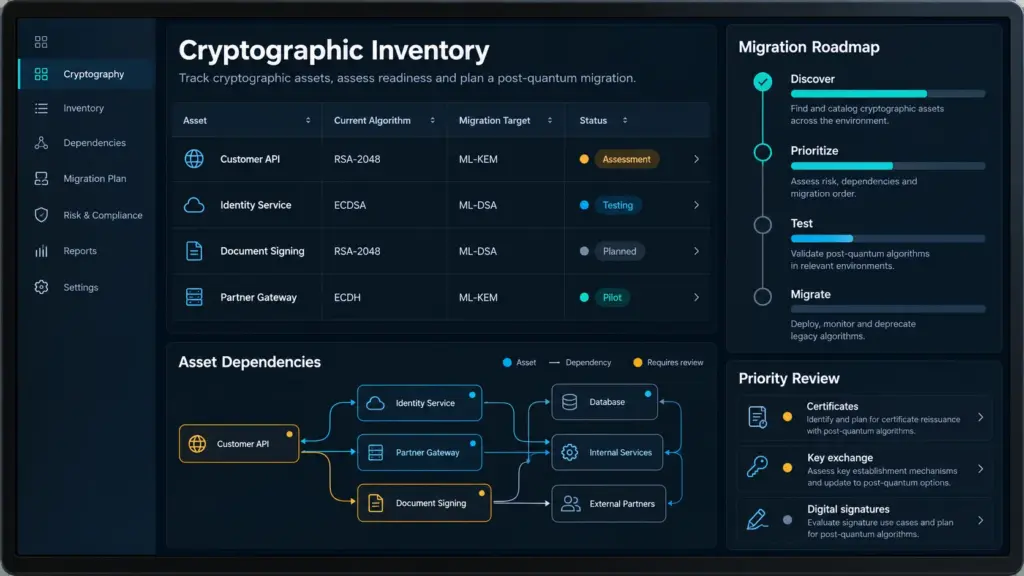
Think about where cryptography hides. It’s in your web servers, API gateways, and identity providers. It’s inside firmware updates, IoT devices, and third-party SaaS tools. It’s baked into hardware security modules and partner integrations you didn’t build. Your cryptographic infrastructure is a web of dependencies, and some of those dependencies belong to vendors who’ll move at their own pace.
There’s also a practical wrinkle. The new algorithms usually have larger keys and digital signatures than the ones they replace. That can affect network latency, certificate sizes, and storage. Systems with tight limits, like embedded devices, may need real redesign work.
So what does cryptographic agility really mean? In plain terms, it’s the ability to change encryption algorithms, key sizes, and protocols quickly, without rewriting applications or causing outages. Think of it as designing your systems so the algorithm is a setting, not a foundation.
Plenty of organizations learned this lesson the hard way during past transitions, like the long retirement of older hashing methods. Hardcoded algorithms, scattered libraries, and undocumented dependencies turned simple upgrades into multi-year projects. Agility prevents a repeat.
An agile design usually includes a few traits:
This is also where cryptographic agility pays off beyond quantum. The next vulnerability in a widely used algorithm will arrive eventually, quantum or not. Teams with agility respond in weeks. Teams without it respond in years.
A workable PQC migration roadmap for enterprises doesn’t start with picking algorithms. It starts with knowing what you have. Here’s a sequence that holds up in practice.
Treat this as a multi-year program with executive sponsorship. Compliance teams, architects, and procurement all have a seat at the table.
Moving to quantum-safe security works best when it’s folded into work your teams already do. Add cryptographic checks to architecture reviews. Include algorithm requirements in security questionnaires for new vendors. Track progress with a few simple metrics, such as the share of systems inventoried and the number of hardcoded algorithm dependencies remaining.
For client-facing teams, this is also a trust conversation. Enterprise buyers are starting to ask suppliers how they plan to deliver quantum-resistant encryption for businesses that handle sensitive exchanges. A clear, honest answer builds confidence. Silence raises eyebrows.
Start small if you need to. Pick one high-value system, run it through inventory, risk ranking, and a pilot. What you learn will make the broader rollout faster and far less painful.
Post-quantum cryptography refers to cryptographic algorithms designed to stay secure against attacks from both classical and quantum computers. They run on ordinary hardware and software, and they replace vulnerable methods like RSA and elliptic curve schemes.
Because encrypted data can be harvested today and decrypted once quantum capability matures. Businesses holding long-lived sensitive information, such as contracts, financial records, and customer data, face real exposure. Early adoption of post-quantum cryptography also helps meet emerging regulatory and client expectations.
Cryptographic agility is the ability of a system to switch algorithms, keys, and protocols quickly without major redesign or downtime. It treats the algorithm as a replaceable component rather than a fixed part of the architecture.
Migration involves swapping algorithms across hundreds of systems, many owned by third parties. Cryptographic agility lets teams roll out changes in phases, run old and new methods in parallel, and respond fast if a new algorithm shows weaknesses.
Start with a full cryptographic inventory, rank systems by data sensitivity and lifespan, and ask vendors for their timelines. Pilot hybrid approaches on a high-value system, centralize crypto libraries, and build a phased plan for post-quantum cryptography adoption with clear ownership.