Discover how composable ERP, AI microservices, and modular architecture are helping enterprises modernize legacy ERP systems and improve business agility.
For three decades, the ERP was the undisputed center of gravity for enterprise software. One system, one vendor, one database, one truth. That model made sense when businesses moved slowly and change came in yearly release cycles. It doesn’t make sense anymore.
Today’s enterprises need to move fast, plug in new capabilities on demand, and adapt without waiting on a multi-year ERP transformation roadmap. That’s why a growing number of IT leaders are pulling capabilities out of their monolithic ERP software and replacing them with smaller, purpose-built tools. This shift has a name: the Micro-SaaS migration, and it’s changing what “enterprise software” even means.
Legacy ERP platforms were built for a world of predictable processes and centralized IT control. They’re rigid by design. Every customization sits on top of a core that resists change, and every upgrade risks breaking something downstream. For CIOs trying to keep pace with market shifts, that rigidity has become a real liability.
Enterprise AI has raised the stakes further. Businesses want intelligent forecasting, anomaly detection, and automated decisioning baked into their daily workflows, not bolted on as an afterthought two years from now. Traditional ERP vendors are trying to catch up, but their release cycles were never built for this pace of innovation. That gap is exactly where Micro-SaaS vendors are stepping in.
A Micro-SaaS product does one job and does it exceptionally well. Think a single tool for demand forecasting, another for vendor risk scoring, another for expense anomaly detection. Instead of forcing every function through a single sprawling platform, enterprises are assembling a stack of specialized tools that each solve one problem with precision.
What makes this approach viable at enterprise scale is AI microservices. These are discrete, independently deployable AI-powered services that plug into existing systems through APIs. A finance team can add an AI microservices layer for cash flow prediction without touching procurement’s tools. A supply chain team can deploy a demand-sensing model without waiting for a broader platform upgrade. Each service is small, focused, and replaceable, which is precisely the point.
This is the foundation of a true microservices architecture for enterprise applications: independent components that communicate through well-defined interfaces, scale on their own schedules, and get swapped out the moment a better tool shows up. It’s a sharp departure from the “rip and replace the whole platform” thinking that defined ERP upgrades for years.
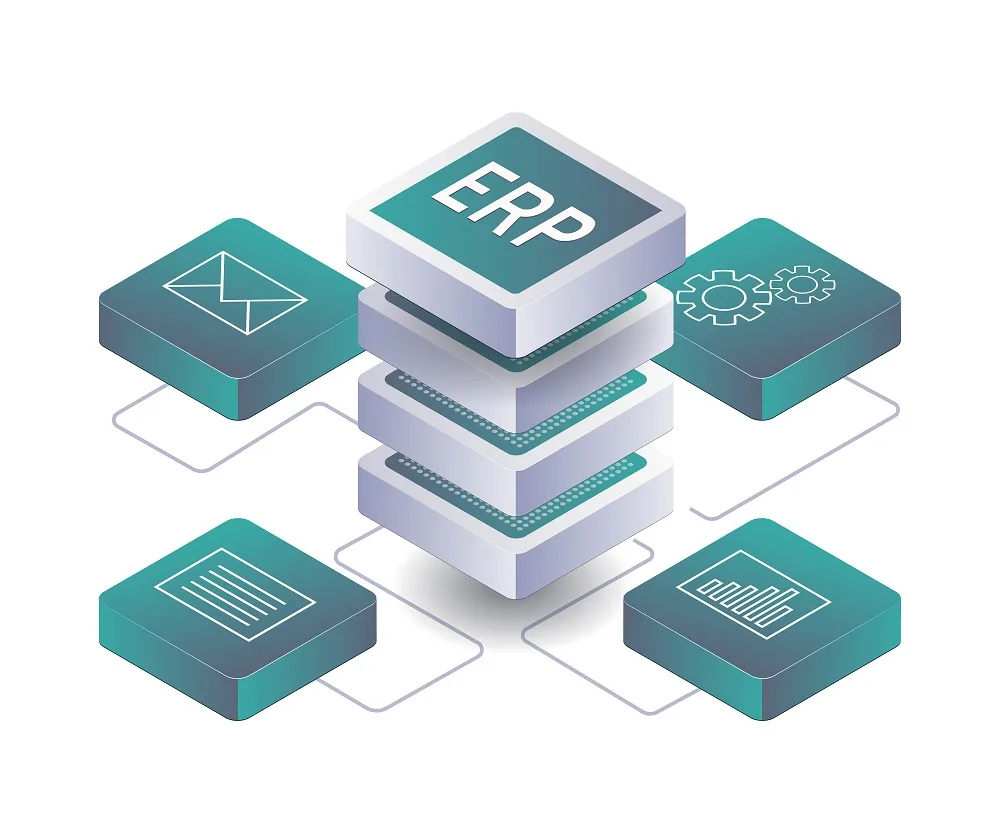
This is where modular ERP comes in. Rather than treating the ERP as a single monolith, composable ERP breaks the platform into a set of business capabilities, finance, procurement, HR, logistics, that can each be sourced, upgraded, or swapped independently. The core ERP still handles system-of-record functions, but the intelligence layer on top is built from best-of-breed services.
ERP integration is what makes this practical rather than chaotic. Modern integration platforms and API gateways let enterprises connect a patchwork of specialized tools to their core ERP without custom point-to-point code for every connection. Data flows where it needs to go, and each service stays loosely coupled to the rest of the stack. That loose coupling is what gives composable ERP its resilience: a vendor changing its pricing or shutting down doesn’t take the whole system with it.
Business process automation is the connective tissue across all of this. Instead of manual handoffs between departments, automated workflows route data and triggers between the ERP core and the surrounding microservices, keeping processes moving without constant human intervention.
ERP modernization with AI rarely starts with a full platform rip-out anymore. It starts small. A team identifies one painful, high-friction process, say, invoice matching or demand forecasting, and deploys a focused AI service to fix it. Once that service proves its value, the next one gets added. Over time, the enterprise ends up with a modernized, intelligent operating environment built one capability at a time, rather than one disruptive migration.
This incremental path lowers risk considerably. There’s no single point of failure, no massive change-management event, and no all-or-nothing budget approval. IT leaders can test a Micro-SaaS tool for a single department, measure the results, and expand only where it delivers real value.
The appeal isn’t just technical, it’s financial and strategic. Modular systems let enterprises pay for exactly the capabilities they use, avoid vendor lock-in on any single component, and bring new AI capabilities online in weeks rather than years. When a better forecasting tool comes along, swapping it in doesn’t require touching the rest of the stack.
For CFOs and CTOs alike, this flexibility translates directly into agility. Enterprises that have unbundled their legacy resource planning platforms report noticeably faster time-to-value on new initiatives, tighter budget control, and far less friction whenever priorities shift midway through a quarter.
The shift toward composable ERP and AI microservices isn’t a passing trend, it’s a structural response to how fast enterprise needs are evolving. As more vendors build interoperable, API-first tools, the case for staying locked into a single monolithic platform keeps getting weaker. Enterprises that start unbundling now, one high-value process at a time, will be far better positioned to adapt as AI capabilities keep advancing.
Micro-SaaS refers to small, focused software products built to solve one specific business problem exceptionally well, rather than bundling dozens of features into one large platform.
Composable ERP is an approach where enterprise resource planning is broken into independent capabilities that can be sourced, upgraded, or replaced separately instead of managed as one rigid system.
Traditional ERP centralizes everything in one monolithic platform with slow release cycles. Composable ERP splits functions into independent, swappable services that update on their own timelines.
AI microservices plug into existing systems through APIs to handle specific tasks like forecasting, anomaly detection, or risk scoring, without requiring changes to the rest of the tech stack.
Modular ERP gives enterprises more flexibility, faster deployment of new capabilities, less vendor lock-in, and lower risk since changes happen one component at a time instead of one massive migration.