Learn how B2B software companies align pricing with customer ROI, demonstrate measurable business value, improve pricing decisions, and support revenue growth.
Most software teams can tell you exactly what it costs to build and run their product. Far fewer can tell you what it’s worth to the person signing the contract. That gap is where deals stall, discounts creep in, and good products end up priced like commodities.
Value-based pricing closes the gap. Instead of starting with your costs or your competitors’ price lists, you start with the outcome your buyer gets and price a fair share of it. Let’s walk through how that works, and why it matters more now than it did a few years ago.
Cost-plus pricing is comfortable. You add up hosting, support, and salaries, tack on a margin, and call it done. Competitor-based pricing feels safer still, since nobody gets blamed for matching the market.
The trouble is that neither method says anything about the buyer. A tool that saves a logistics team 400 hours a month and a tool that saves a five-person startup 20 hours might cost the same to deliver. What they’re worth to each customer is wildly different. Flat pricing leaves money on the table with the first and scares off the second.
It also trains your sales team to defend a number instead of a result. When the conversation is only about price, procurement wins. When it’s about outcomes, you do.
At its core, the idea is simple. You estimate the financial benefit a customer gains, such as higher revenue, lower costs, or reduced risk, and set your price as a fraction of that benefit. A common rule of thumb is to capture a modest slice, so the buyer keeps most of the upside and the deal feels like an easy yes.
That’s what customer ROI means in practice. It isn’t a slide at the end of the deck. It’s the anchor for the whole conversation.
This shift also sharpens your software value proposition. “Faster reporting” becomes “finance closes the books four days earlier, which frees roughly 120 analyst hours a quarter.” One of those is a feature. The other is a business case.
Here’s a practical sequence for how to price B2B software based on customer value.
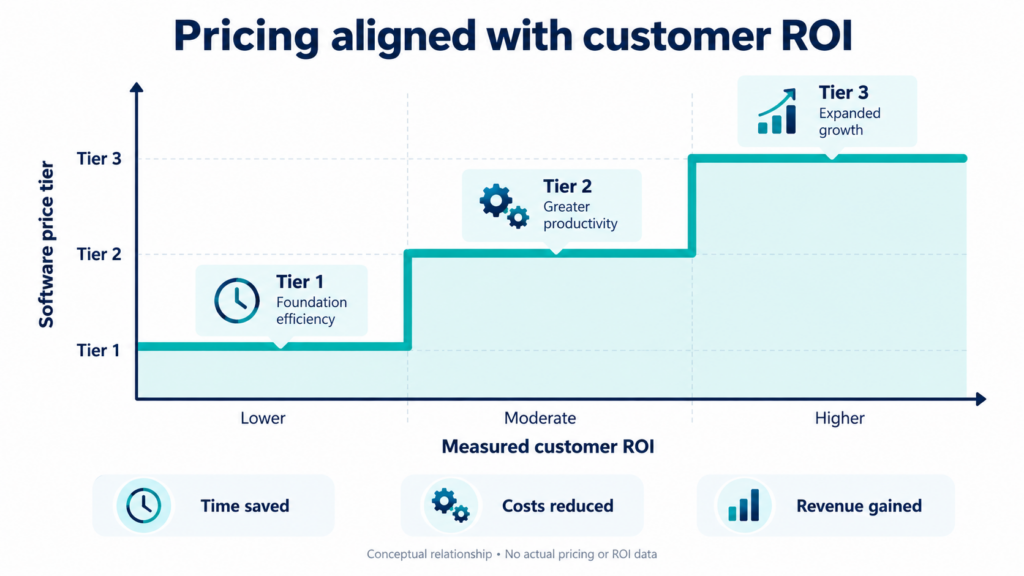
A value-based pricing strategy for SaaS companies has to survive subscriptions, renewals, and expansion. Good tiering helps. Entry plans prove value fast, while higher tiers unlock capabilities that serve bigger, more complex outcomes.
Proof matters just as much. Build ROI calculators, collect before-and-after metrics from existing customers, and fold them into onboarding. Customers who can see their gains renew without drama, and they expand without a hard sell.
Revisit your numbers at least once a year. As your product improves and customers mature, the value you deliver shifts. Treat pricing optimization as an ongoing habit, not a one-time project. Done well, it becomes the backbone of sustainable software monetization, because revenue tracks the benefit customers actually feel.
Pricing is a statement about worth. When it’s grounded in what customers gain, it’s easier to defend, easier to grow, and easier for buyers to say yes to. Start small: pick one segment, quantify one outcome, and test one new price. The data will tell you where to go next. Small, steady experiments beat a dramatic overhaul almost every single time.
It’s a model where the price reflects the measurable benefit a business customer receives, rather than the vendor’s costs or the competition’s rates. The more value delivered, the more the product is worth.
In SaaS, value-based pricing starts with the outcomes your product drives. You choose a value metric like seats or usage, and tier your plans so price scales with the customer’s results. Renewals and expansion then follow the proof of customer ROI.
Subtract the total cost of ownership from the total quantified gains, then divide by that cost. Gains include labor hours saved, revenue lifted, and risks avoided. Use conservative assumptions and validate them with the customer’s own data.
Cost-based pricing starts with what it costs you and adds a margin. Value-based pricing starts with what the product is worth to the buyer. The first caps your upside, while the second ties revenue to results.
Combine customer interviews, win-loss analysis, and price-sensitivity surveys to gauge willingness to pay. Look at what they already spend on the next-best alternative, and test pricing with small cohorts before rolling it out.