Discover how B2B data clean rooms enable secure partner collaboration, privacy-preserving analytics, and marketing measurement without exposing raw customer data.
Two enterprise partners sit down to plan a joint campaign. Both hold rich customer data. Neither can hand it over. Legal says no, security says absolutely not, and the campaign stalls before it starts.
That standoff is why data clean rooms have moved from niche ad-tech tooling into mainstream B2B planning. They give partners a way to work on shared questions without trading the raw records behind them. Here’s how data clean rooms work in B2B marketing, where they help, and what to settle before you begin.
B2B deals involve fewer accounts but far more sensitive information. Firmographics, contract details, buying committee contacts and pipeline stages all carry real risk if they leak. Add GDPR, India’s DPDP Act and a growing list of regional rules, and the old habit of emailing CSV files between partners starts to look reckless.
The stakes are practical, too. A single careless transfer can trigger a breach notification, a strained partnership and weeks of cleanup. Most marketing leaders would rather skip that conversation with their legal team altogether.
Meanwhile, third-party cookies are fading and first-party data is the asset everyone wants to put to work. Teams need secure data sharing that lets them benefit from a partner’s data without holding a copy of it. That’s the gap enterprise data collaboration has struggled to close, and it’s where data privacy in marketing stops being a compliance footnote and becomes a planning requirement.
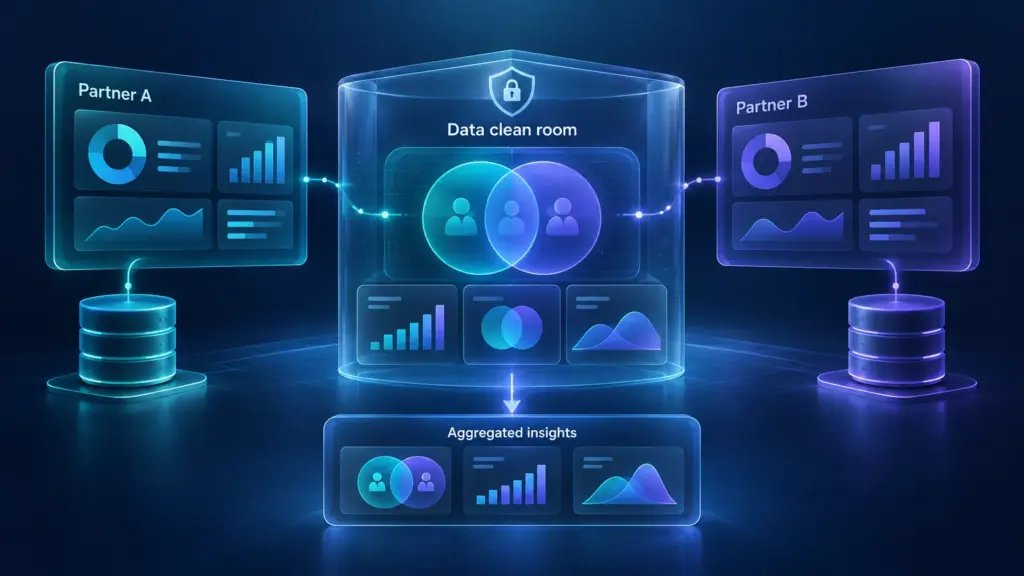
A clean room is a controlled, neutral environment where two or more organizations bring their datasets together for analysis. Nobody sees the other side’s row-level records. Each party uploads data, usually hashed or pseudonymized, and the room returns only aggregated outputs that meet agreed privacy thresholds.
Think of it as a shared kitchen with locked pantries. Everyone cooks in the same space, but nobody opens another team’s cupboards.
Compared with swapping files or building point-to-point integrations, this approach gives partners secure data sharing with controls built in rather than bolted on afterward. The permissions travel with the data, so there’s far less to police manually and far less to explain to auditors later.
The mechanics are easier to grasp as four steps.
Major cloud platforms offer versions of this, and independent providers are building neutral options too. The details differ, but the principle holds.
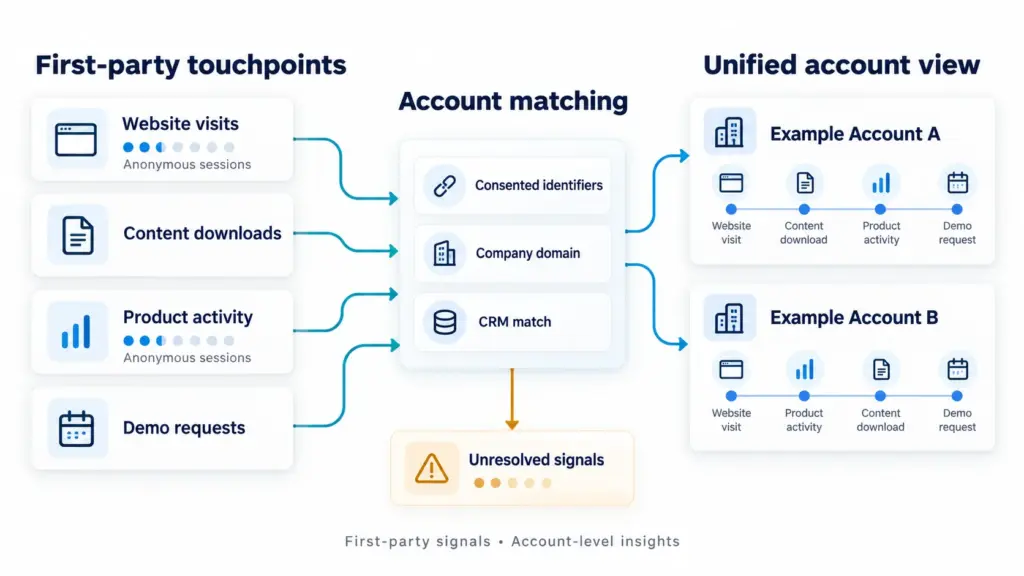
Audience overlap analysis is usually the first win. Before co-marketing, two partners can see how many target accounts they share, which segments overlap and where each has gaps. No account list changes hands.
Measurement is the second. Pair a publisher’s engagement data with your CRM pipeline and you can tie exposure to opportunity creation. That’s the heart of data clean rooms for B2B marketing analytics, and it answers the question sales leaders keep asking: did this partnership actually move deals?
Account-based programs benefit too. Match intent signals against a customer base, find lookalike accounts, then activate them through approved channels. And when a distributor, a channel partner and your own team all touch the same account, a shared view ends the usual arguments over credit. Each of these use cases starts small and stays contained, which is exactly why procurement and security teams tend to support them. Nobody is being asked to approve a data transfer, only a shared analysis.
A clean room is only as safe as the rules around it. Data governance decides who can run queries, which fields are visible, how long data persists and what counts as an acceptable output. Skip it and you’ve built a fancier version of the shared spreadsheet.
Settle these before onboarding a partner:
Strong data governance also speeds things up. Legal and security teams approve faster when controls are documented rather than promised.
Clean rooms aren’t magic. Match rates in B2B can be modest because business emails change and account identifiers vary. Setup takes effort, and SQL or data engineering skills are usually needed. Differences between platforms can complicate cross-cloud work. Start with one focused use case, prove the value, then widen the scope.
Expectations matter as well. Enterprise data collaboration works best when each side knows what it’s contributing, what it expects back and how success will be judged. Agree on two or three metrics up front, such as shared-account counts or pipeline influenced, so the first review is a conversation about results instead of a debate about definitions.
Pick a partner you already trust, define one question worth answering and agree on the rules before touching any data. A narrow pilot, such as a single audience overlap analysis, builds confidence quickly. From there, safe collaboration becomes a routine part of how you plan campaigns, not a special project. Done well, data privacy in marketing turns into a shared habit rather than a hurdle.
A data clean room is a protected environment where companies combine datasets for analysis without exposing individual records. Partners get aggregated insights, and the platform enforces the privacy rules automatically.
Each party loads hashed data into a secure space, the room matches records, and approved queries return only aggregated results. Raw data never leaves its owner.
They let partners measure campaigns, find shared accounts and plan joint programs while staying inside privacy rules. You get the insight without the legal headache.
Yes. Hashed identifiers let the room find overlap and return counts or segments, never the underlying rows. That’s secure data sharing in practice: both sides learn what they need and nothing more.
Through hashing, query controls, aggregation thresholds and audit logs, all tied to data governance rules the partners agree on up front. Nothing identifiable leaves the room.